



Dental Implants for Seniors Over 65 in the USA in 2026: Medicare, Costs, and Safer Alternatives
If you are over 65 and missing one or more teeth, you have probably heard two very different stories about dental implants. One story says implants are the closest thing to natural teeth. The other story is the bill.
Both stories are true. Implants can restore chewing, speech, and confidence in a way that a loose denture often cannot. They can also cost several thousand dollars per tooth, and the insurance most seniors rely on does not pay for them.
This guide gives you the direct answer first, then the numbers, the Medicare rules, and the alternatives, so you can decide with a clear head and a written estimate in hand.
The direct answer
Original Medicare (Parts A and B) does not cover dental implants in 2026. Medicare states this plainly: in most cases, Medicare does not cover routine dental services such as cleanings, fillings, extractions, dentures, or implants.
Some Medicare Advantage (Part C) plans offer a dental benefit that may pay part of an implant, but the annual maximum is usually only about $1,000 to $2,000. That covers a fraction of one implant.
A complete single-tooth implant in the USA in 2026 commonly costs $3,000 to $6,000 without insurance, including the post, the abutment, and the crown. A full arch can cost $15,000 to $35,000 or more per arch. Those are planning ranges from 2026 consumer guides, not quotes. Your price depends on your bone, your location, whether you need a graft or an extraction first, and who places the implant.
If implants are not right for you, or not affordable right now, a well-fitted denture or an implant-supported overdenture may be a safer and far cheaper option. The right choice is not the most expensive one. It is the one that fits your mouth, your health, and your budget.
What a dental implant actually is
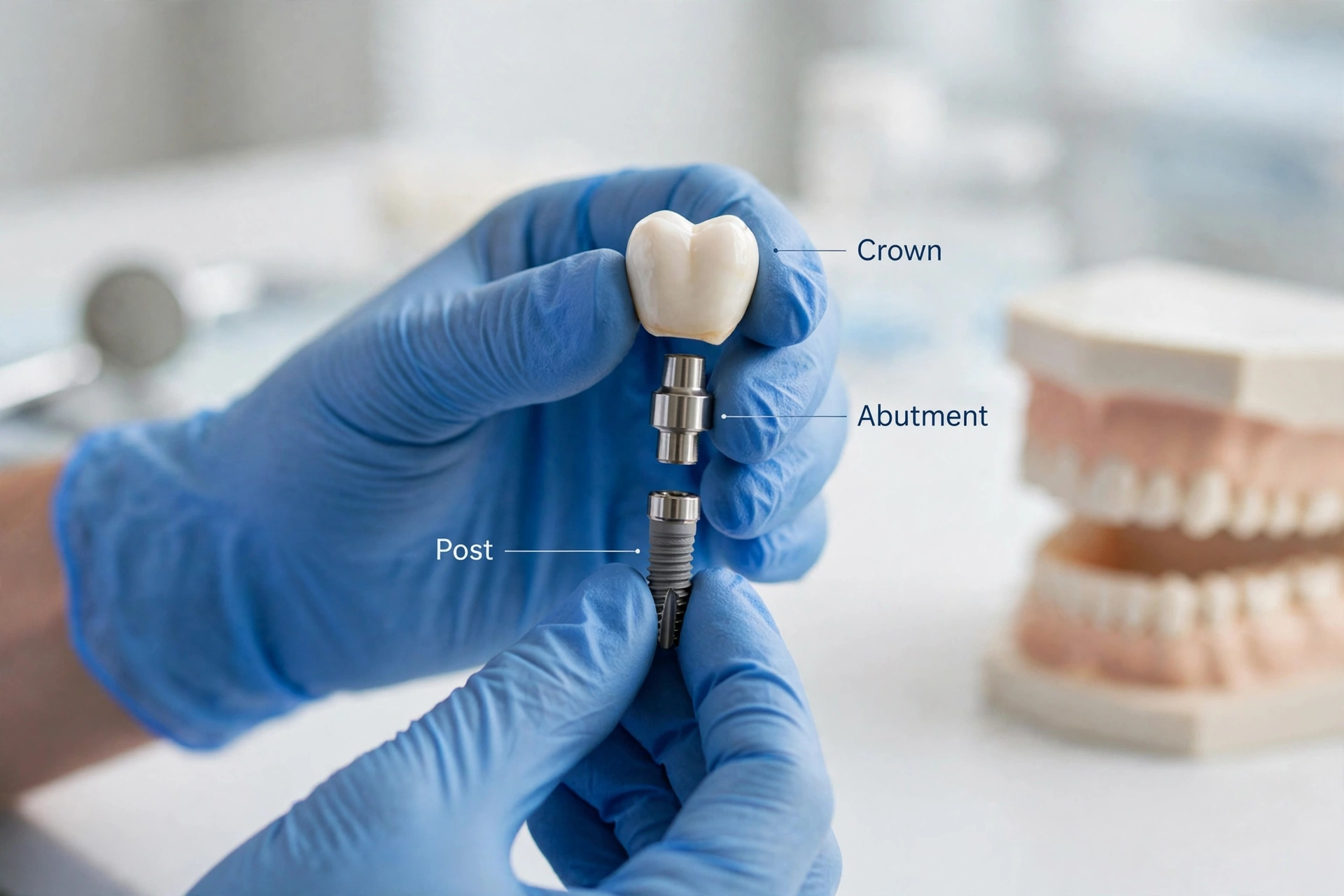
A dental implant is not one thing. It is three parts, placed over more than one visit:
- The post. A small titanium post placed in the jawbone. It acts as the root of the missing tooth. In billing, this is often CDT code D6010.
- The abutment. A small connector that joins the post to the crown.
- The crown. The visible tooth, made to match your other teeth.
That is why a single “implant price” can be confusing. One office may quote only the post. Another may quote all three parts together. Always ask: “Does this price include the post, the abutment, and the crown, plus imaging and follow-up visits?” If the answer is no, the real total will be higher.
Healing also takes time. After the post is placed, the bone needs months to grow around it before the final crown is fitted. Implants are not a one-visit fix, and any clinic that promises otherwise deserves a second opinion.
How much do dental implants cost for seniors in 2026?
Use the table below as a planning guide. Prices vary widely by state, by city, and by whether a general dentist or a specialist (oral surgeon or periodontist) places the post.
| Treatment | Typical range without insurance (2026 guides) | What it includes |
|---|---|---|
| One complete single-tooth implant | $3,000–$6,000 | Post, abutment, and crown |
| Implant post alone | $1,500–$3,000 | Surgery to place the post only |
| Abutment alone | $300–$500 | Connector only |
| Implant crown alone | $1,000–$3,000 | Final tooth only |
| One arch (All-on-4 style, acrylic) | $15,000–$25,000 per arch | Multiple implants plus a fixed bridge for that arch |
| One arch (zirconia) | $25,000–$38,000 per arch | Premium material; higher end of the range |
| Tooth extraction, if needed | $200–$600 | Removing the failing tooth first |
| Bone graft, if needed | $400–$1,200 | Adding bone where the jaw is too thin |
| Sinus lift, if needed (upper jaw) | $1,500–$3,000 | Lifting the sinus floor to make room for an implant |
| 3D cone beam scan | $150–$400 | Detailed imaging for planning |
Sources for these ranges: 2026 consumer cost guides seen 5 Nov 2026 (CoveredUSA, DentalCostsCalculator, FairVisitHealth, The Oral Health). They describe their figures as typical ranges based on FAIR Health Consumer benchmarks and dental fee surveys. Actual fees are set by each practice.
Why two seniors can get very different quotes
- Bone. If you lost the tooth years ago, the jawbone may have shrunk. A graft adds cost and months.
- Location. Fees in large coastal cities are usually higher than in smaller towns.
- Provider. A specialist may charge more than a general dentist, and may be the right choice for a complex case.
- Material. A zirconia full-arch bridge costs more than an acrylic one.
- Extras. Sedation, a temporary tooth, and follow-up visits may or may not be included in the headline price.
Ask every office for the same thing: an itemised written estimate, a Good Faith Estimate if you are paying yourself, and a clear statement of what is not included. If two quotes look very different, check whether they include the same parts before you compare them.
Does Medicare cover dental implants?
Original Medicare: no, in almost every case
Medicare.gov states that in most cases, Medicare does not cover dental services like routine cleanings, fillings, tooth extractions, or items like dentures and implants. You pay all costs for non-covered services, including most dental services.
There is a narrow exception. Medicare may cover some dental services that are directly related to a covered medical treatment, for example an oral exam and dental treatment before a heart valve replacement, an organ transplant, or cancer treatment, or treatment for a complication during head and neck cancer treatment. A routine implant to replace a missing tooth is not in that exception.
No law passed by 5 Nov 2026 changed this. Bills to add dental coverage to Medicare have been introduced in Congress, but none had passed at the time of checking.
Medicare Advantage (Part C): sometimes, but only a little
Medicare Advantage plans are private plans that replace Original Medicare. Many of them include some dental benefit. That does not mean they cover implants well.
What to check in your own plan, in writing, before you book anything:
- Does the plan cover implants at all? Some plans exclude them entirely.
- What is the annual dental maximum? Many plans cap all dental care at about $1,000 to $2,000 a year. One implant can cost more than twice that.
- Is there a separate implant limit? Some plans have a lifetime implant maximum, for example $3,000 or $4,000, on top of the annual cap.
- Is there a waiting period? Some plans make you wait 6 to 12 months before major work is covered.
- Is there a missing-tooth clause? Some plans will not pay to replace a tooth that was already missing before you joined.
- Which dentists are in network? Going out of network can cut the benefit sharply or remove it.
Call the number on your plan card and ask about CDT codes D6010 (implant placement) and D6065 or D6066 (implant crown). Write down the name of the person you spoke to, the date, and what they said. A verbal promise is not coverage. The plan’s Evidence of Coverage is.
Medicaid: it depends on your state
Medicaid dental coverage for adults varies by state. A few states cover implants when they are medically necessary. Most do not, or cover only dentures and basic care. Check your state Medicaid dental page, not a national blog, before you assume anything.
VA benefits: ask, do not assume
Some veterans may have dental coverage through the VA, depending on their service-connected status and eligibility class. Coverage and waiting lists vary. Contact the VA directly rather than relying on a clinic’s advertisement.
Can seniors get implants safely? The questions that matter more than age
Age alone does not disqualify you from implants. Health does. Your dentist will look at:
- Gum disease. Active gum disease must be treated first. The CDC reports that about 47.2% of US adults aged 30 and older have some form of periodontal disease, rising to about 70% at age 65 and older. Implants placed in an unhealthy mouth are more likely to fail. For more on why early gum treatment matters, see our guide on How Can Early Remedy of Gum Illness Save Your Smile.
- Bone. You need enough healthy jawbone to hold the post. If not, a graft may help, or implants may not be the right option.
- Diabetes. Diabetes and gum disease affect each other in both directions. The CDC notes that gum disease is more common in people with diabetes, and that it can affect insulin sensitivity and increase the risk of heart and kidney disease in diabetes patients. Well-controlled blood sugar matters more than the diagnosis alone. Ask your dentist what A1C level they want to see before surgery, and ask your doctor whether that target is realistic for you.
- Smoking and vaping. Smoking slows healing and raises the risk of implant failure. Tell your dentist honestly if you smoke or vape.
- Medicines. Blood thinners, osteoporosis medicines (such as bisphosphonates), and some other drugs can affect healing or surgery planning. Bring a full medicine list, including over-the-counter products and supplements, to your consultation.
- Heart disease. Gum disease and heart disease are associated, but the American Heart Association’s December 2025 scientific statement is clear that causality has not been established. Treating gum disease is still important, and your dentist and cardiologist may need to coordinate care, especially if you take blood thinners. Read our guide on What Science Says About the Link Between Oral Health and Heart Disease.
- Dry mouth. Many common medicines cause dry mouth, which raises cavity and gum risk around implants. Tell your dentist about dry mouth, and ask about fluoride and saliva care.
The American Dental Association’s advice on implants is straightforward: expect a full examination first, then a conversation about the full range of options, including crowns, bridges, implants, and dentures, based on your diagnosis, your oral health, and your preferences. If you are uncomfortable with a recommendation, get a second opinion. Discuss financing only after you have discussed the treatment options.
If a clinic pressures you to decide on the same day, to remove healthy teeth to place implants, or to sign a finance agreement before you have a written treatment plan, walk away and get a second opinion.
Alternatives to implants: cheaper, and sometimes better
| Option | Typical cost range (2026 guides) | Best for | Main drawback |
|---|---|---|---|
| Complete dentures (upper or lower) | $1,000–$3,000 per arch | No teeth, or many missing teeth, on a tight budget | Can slip; chewing is weaker; bone keeps shrinking underneath |
| Partial denture | $500–$2,500 | A few missing teeth with healthy teeth remaining | Clasps can show; needs careful cleaning |
| Dental bridge | $2,000–$5,000 for a three-unit bridge | One missing tooth with strong teeth on either side | The neighbouring teeth must be filed down |
| Implant-supported overdenture (2 implants) | $6,000–$12,000 per arch | Loose lower denture that will not stay in place | Still removable; needs implant maintenance |
| Single implant | $3,000–$6,000 | One missing tooth, healthy bone and gums | Highest cost per tooth; longest treatment time |
| Do nothing (for now) | $0 now, but later costs possible | A missing back tooth with no pain and no shifting | Remaining teeth can drift; chewing and bone loss can worsen |
A bridge can be a good middle choice for one missing tooth. A well-made denture can be a good choice when many teeth are missing and the budget is limited. An overdenture with two implants can transform a loose lower denture without the cost of a full arch of implants.
There is no shame in choosing the cheaper option. A treatment you can afford, keep clean, and maintain is better than a treatment you cannot finish.
How to lower the cost without lowering the standard of care
- Get two written estimates. Compare the same parts, not just the headline number.
- Ask about dental schools. University dental schools, supervised by experienced faculty, often charge 30% to 50% less than private practices. Treatment takes longer, with more visits. Check that the school is accredited and ask who supervises the work.
- Ask about phased treatment. Can the post be placed now and the crown later, so the cost is spread over two calendar years and two annual maximums? Ask your dentist and your plan whether that helps.
- Ask about a dental savings plan. This is not insurance. You pay an annual fee (often about $100–$200) and get a discount of roughly 20% to 60% at participating dentists. There is no annual maximum and no waiting period, but the discount applies only at participating offices. Read the terms before you join.
- Ask about payment plans, carefully. Many offices offer financing. Ask for the total cost including interest, the monthly payment, and what happens if you miss a payment. Do not sign a finance agreement in the chair.
- Check community clinics. Federally Qualified Health Centers and community dental clinics may offer lower fees or a sliding scale. They rarely offer implants, but they can treat gum disease and fit dentures, which may be the right first step.
- Do not travel abroad for a cheap implant without a plan. Dental tourism can look cheap until you need follow-up care, a repair, or treatment for a complication at home. If you consider it, ask who will provide follow-up care in the USA, and get that answer in writing.
Be wary of any advertisement that promises “free implants” or “Medicare pays for implants.” No federal grant pays for implants directly to individuals, as far as was verified on 5 Nov 2026. If someone promises free implants, ask for the programme name, the eligibility rules in writing, and a phone number you can call to verify it.
What to ask at your implant consultation
Take this list with you:
- Am I a good candidate for an implant, and why? What about my bone, gums, and medicines?
- What is the full itemised cost, including imaging, surgery, the abutment, the crown, sedation, and follow-up visits?
- What are my alternatives, and what would each cost over five years, including maintenance?
- How long will treatment take, from first visit to final crown?
- What happens if the implant fails? Is revision covered, and for how long?
- How do I clean around the implant, and how often should I come back?
- Will you coordinate with my doctor about my medicines and my diabetes or heart condition?
- Can I have a written copy of the treatment plan and the estimate to take home?
A good dentist will welcome these questions. If you feel rushed, get a second opinion.
How digital dentistry fits in
Modern implant planning often uses 3D imaging and digital guides to place the post more precisely. That can mean a shorter surgery and a better-fitting crown, but it does not make an unsuitable case suitable. Technology helps a good plan. It does not replace one. For background, see How Digital Dentistry is Making Dental Therapy Higher? and our overview of Newest Advances in Dental Implant Surgical procedure.
Frequently asked questions
Does Medicare pay for dental implants for seniors?
No. Original Medicare (Parts A and B) does not cover routine dental care, including implants, in most cases. Some Medicare Advantage plans offer a limited dental benefit, but the annual maximum is usually only about $1,000 to $2,000, which covers a fraction of one implant. Check your own plan’s Evidence of Coverage.
How much does one dental implant cost for a senior in the USA in 2026?
A complete single-tooth implant commonly costs $3,000 to $6,000 without insurance, including the post, abutment, and crown. Extractions, bone grafts, sinus lifts, imaging, and sedation can raise the total. Always ask for an itemised written estimate.
Are dental implants safe after 65?
Age alone is not the deciding factor. Bone, gum health, diabetes control, smoking, and medicines matter more. Your dentist should examine you fully and, if needed, coordinate with your doctor before recommending implants.
Can diabetics get dental implants?
Many people with diabetes can, if their blood sugar is well controlled and their gum disease is treated first. Poorly controlled diabetes raises the risk of slow healing and implant problems. Ask your dentist what A1C level they look for, and ask your doctor whether that target is right for you.
What is the cheapest alternative to a dental implant?
A removable partial or complete denture is usually the cheapest option. A bridge is a middle option for one missing tooth. An implant-supported overdenture costs more than a denture but far less than a full arch of implants, and it can fix a loose lower denture.
Are there free dental implants for seniors?
No federal programme that pays for implants directly to individuals was verified on 5 Nov 2026. Some charities and dental schools may help eligible low-income seniors, but availability is limited and eligibility rules apply. Be cautious of any advertisement that promises free implants without naming the programme.
How long do dental implants last?
Implants can last many years with good daily cleaning, regular dental visits, and healthy gums. They are not guaranteed for life. Smoking, untreated gum disease, and poor cleaning shorten their life. Your dentist should explain maintenance and follow-up before you decide.
The bottom line
- Original Medicare does not cover dental implants in 2026.
- One complete implant commonly costs $3,000 to $6,000. A full arch costs far more.
- Medicare Advantage may help a little, but it rarely covers an implant in full.
- Age is not the barrier. Bone, gums, diabetes control, smoking, and medicines are.
- Get a written, itemised estimate, compare alternatives over five years, and get a second opinion if you feel pressured.
If implants are right for you, they can be worth the cost. If they are not, a well-fitted denture or bridge is not a failure. It is a sensible choice, and it is far better than leaving gum disease untreated or avoiding the dentist because the price feels out of reach.