


Gum Disease and Heart Disease: What the December 2025 AHA Update Changed (and What It Did Not)
If you have gum disease, does it raise your risk of heart disease? In December 2025, the American Heart Association gave its clearest answer yet, and the answer is more careful than most headlines suggest. Yes, the link is now stronger than it was. No, it has not been proven that gum disease causes heart attacks, and no, there is no direct evidence that treating gum disease prevents them.
That careful middle is the whole point of this guide. It explains what the December 2025 AHA statement actually changed, what it deliberately did not change, what the numbers behind it mean for an ordinary patient in the USA, and what to ask your dentist and your doctor at your next visit.
This guide is general education, not medical advice. If you have heart disease, diabetes, or other risk factors, discuss dental screening with your own dentist and doctor. Nothing here replaces that conversation.
The short answer
On 16 December 2025, the American Heart Association published a new scientific statement in its flagship journal, Circulation, titled “Periodontal Disease and Atherosclerotic Cardiovascular Disease”. It updates the Association’s 2012 statement on the same subject, thirteen years later. The writing group was chaired by Andrew H. Tran, M.D., M.P.H., M.S., FAHA, a pediatric cardiologist at Nationwide Children’s Hospital in Columbus, Ohio.
The statement’s headline finding is that periodontal disease, the clinical name for gum disease, is associated with atherosclerotic cardiovascular disease, the plaque buildup in arteries that leads to coronary heart disease, stroke, peripheral artery disease, and aortic aneurysm. New data since 2012 support that association, and emerging data point to an independent association that goes beyond the risk factors the two conditions share, such as smoking and diabetes.
The statement is equally clear about its limit. A cause-and-effect relationship has not been confirmed. There is no direct evidence that periodontal treatment will help prevent cardiovascular disease. Treatments that reduce lifetime exposure to inflammation “appear to be beneficial” and “could potentially decrease the burden” of cardiovascular disease. Those are the AHA’s own careful words, not a promise. Any article that turns this update into “floss and you will not have a heart attack” has gone further than the evidence.
This is not the first time we have covered this link. Our June 2025 post, What science says about the link between oral health and heart disease, explained the evidence as it stood before this update. This post is the update to that post: here is what is new since June 2025, and here is what is still not settled.
What the AHA statement is, and what it is not
A scientific statement is not a guideline. That distinction matters, because it decides what you should expect from this document. A guideline tells clinicians what to do. A scientific statement reviews the evidence, states where the science stands, and informs the guidelines that come later. This statement makes no treatment recommendations. It does not tell dentists to screen every heart patient, and it does not tell cardiologists to prescribe dental treatment.
What it does is synthesise thirteen years of new evidence since the 2012 statement. Four kinds of evidence carry the update: Mendelian randomisation studies, which use genetic variants as a natural experiment; periodontal intervention trials, which test what happens when gum disease is treated; studies of inflammatory and vascular markers; and studies of shared susceptibility genes. Together, that evidence moved the AHA from the cautious position of 2012 to a firmer statement of association in 2025. It did not move the AHA to a claim of causation, because the decisive evidence for that, long-term randomised trials showing that periodontal treatment changes heart outcomes, still does not exist.
What changed, and what did not
| What changed in December 2025 | What did not change | |
|---|---|---|
| The link itself | New data support an association between periodontal disease and atherosclerotic cardiovascular disease, including an independent association beyond shared risk factors | The link is still an association. Cause and effect have not been confirmed |
| The evidence base | Mendelian randomisation, intervention trials, inflammatory markers, and shared genes were added to the picture | The evidence is still indirect in key places. No long-term trial has shown that treating gum disease changes heart outcomes |
| Who should pay attention | People with one or more cardiovascular risk factors “may particularly benefit from regular dental screenings and targeted periodontal care to mitigate systemic inflammation” | This is a suggestion about who may benefit from screening, not a treatment recommendation and not a screening rule |
| The advice to patients | Prevention and treatment of gum disease “could potentially decrease the burden” of cardiovascular disease | There is no direct evidence that periodontal treatment prevents heart attacks, strokes, or cardiovascular death |
| The status of the document | A scientific statement that informs future guidelines | It is not a guideline and it makes no treatment recommendations |
The table is the article in miniature. If you remember only one row, remember the second column of the first row: association, not causation.
The link in plain language: what gum disease is associated with
The statement links periodontal disease with a higher risk of several cardiovascular outcomes. The list is specific: heart attack, stroke, atrial fibrillation, heart failure, peripheral artery disease, chronic kidney disease, and cardiac death, plus cardiometabolic conditions. Each of those is an association found across studies, not a proven consequence of gum disease in any one patient.
Gum disease is common enough that the scale matters. Periodontal disease affects over 40 percent of US adults over age 30, according to the AHA. That is not a rare condition with a rare link. It is a common condition with a link that, if real, would touch a large share of the adult population. That is why the AHA took the trouble to update the statement at all.
Two mechanisms are proposed for how the link might work, and both are plausible rather than proven as the causal chain. The direct route is bacteria entering the bloodstream, a process called bacteremia, and infecting blood vessels. The indirect route is chronic systemic inflammation: inflamed gums keep the immune system activated, and that activation damages blood vessels over time. Antibody cross-reactivity, thrombotic factors, and the oral microbiome are part of the same indirect picture. The statement’s chair, Dr. Tran, put it in plain terms: “Gum disease and poor oral hygiene can allow bacteria to enter the bloodstream, causing inflammation that may damage blood vessels and increase the risk of heart disease.”
Shared risk factors complicate the picture. Poor oral hygiene, high blood pressure, overweight and obesity, diabetes, and smoking all raise the risk of both conditions, and gum disease is more common in men, in older adults, and in people with less access to dental care. Part of the association is explained by these shared factors. The new evidence suggests the association survives even after accounting for them, which is what “independent association” means, but shared risk still explains a large part of what any one patient experiences.
The numbers: how big is the link, and what the brushing figure really means
Two figures from the statement are worth reading carefully, because both are easy to misread.
The first is the scale figure: over 40 percent of US adults over age 30 have periodontal disease. A secondary source puts it at about 42 percent, with about 7.8 percent severe. It tells you this is not a fringe problem, but it does not tell you your personal risk, which depends on the stage of your gum disease, your other risk factors, and your age.
The second is the brushing-frequency figure, and it needs the most care. Studies cited by the statement found a 10-year risk of atherosclerotic cardiovascular disease of 13.7 percent for people who brushed once daily or less, compared with 7.35 percent for people who brushed three or more times per day, along with reduced inflammatory markers in the more frequent brushers. Read that as an association from the cited studies, not as a promise. It does not mean brushing three times a day cuts your risk in half. People who brush three times a day also differ in other ways, including diet, smoking, income, and access to care, and the studies cannot separate all of that out. What the figure does show is that oral hygiene tracks with cardiovascular risk in a consistent direction, and that the size of the gap is large enough to take seriously.
That is the pattern of this whole update. The numbers are real, the direction is consistent, and the proof of cause is still missing.
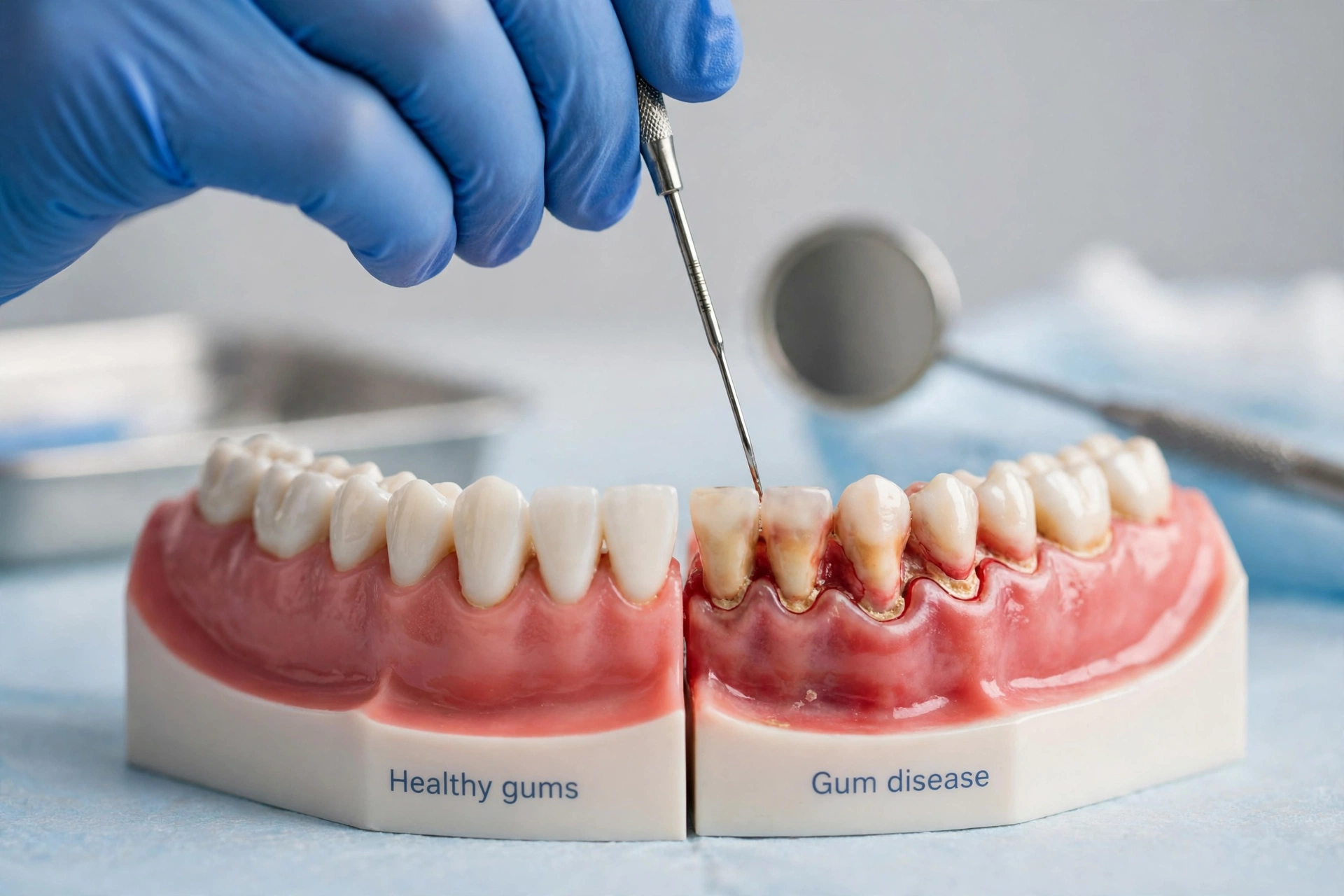
The stages of gum disease, from gingivitis to severe periodontitis
Gum disease is not one condition. It is a progression, and where you are on that progression changes both the dental treatment and the conversation with your doctor.
| Stage | What is happening | What you may notice | What it usually needs |
|---|---|---|---|
| Gingivitis | The earliest stage. Plaque irritates the gums and they become inflamed | Gums bleed when you brush or floss, but there is no bone loss yet | Better daily cleaning and a professional cleaning. At this stage the damage is usually reversible |
| Early periodontitis | Inflammation reaches the tissues and bone that support the teeth. Small pockets form between teeth and gums | Bleeding continues, gums may recede slightly, breath may change | Deep cleaning below the gum line, usually called scaling and root planing, plus closer monitoring |
| Moderate periodontitis | Pockets deepen and trap more bacteria. Bone loss becomes measurable | Teeth may feel slightly loose, gums recede further, chewing may feel different | Deep cleaning, sometimes with local antibiotics or minor surgery, and more frequent maintenance visits |
| Severe periodontitis | Supporting bone is badly damaged. Teeth may loosen and fall out, and surgery is often needed | Loose teeth, shifting teeth, pain when chewing, persistent infection | Surgical treatment, and in some cases extraction followed by replacement |
Catching gum disease at the gingivitis stage is the cheapest and simplest version of this story, because gingivitis is usually reversible with cleaning and better daily care. Once bone is lost, it does not grow back on its own. That is the practical reason to act early, and it has nothing to do with the heart link. How early treatment of gum disease can save your smile
When teeth are lost to severe periodontitis, replacement becomes its own decision, with its own costs and trade-offs. For older patients, that often means implants, and the numbers there are worth knowing in advance. Our guide for seniors over 65 covers Medicare, costs, and safer alternatives in the USA in 2026: Dental Implants for Seniors Over 65 in the USA in 2026: Medicare, Costs, and Safer Alternatives
What the newest research adds, and what it still does not prove
The AHA statement itself is the main event, but two studies published around it help explain why the conversation moved. Both are real, both are citable, and neither proves causation.
The first is an August 2025 study from Tampere University in Finland, published in the Journal of the American Heart Association. Researchers found genetic material, DNA, from viridans streptococci, bacteria central to plaque formation, embedded directly inside ruptured atherosclerotic plaques. Finding oral bacteria inside a ruptured plaque supports the direct mechanism, bacteria travelling from the mouth to the arteries. It does not prove those bacteria caused the rupture. They could have arrived after the damage, or with it, rather than causing it.
The second is a large nationwide cohort study published in the International Journal of Cardiology in early 2026. It followed more than 568,000 people across two decades and found that poor oral health in childhood was associated with a significantly higher risk of atherosclerotic cardiovascular disease in adulthood, including ischemic heart disease, myocardial infarction, and stroke. A cohort that large, followed that long, is strong evidence of an association that starts early in life. It is still an association. Childhood oral health tracks with adult income, diet, smoking, and access to care, and no cohort study can fully separate those threads.
Who should pay the closest attention
The statement singles out one group: people with one or more cardiovascular risk factors, who “may particularly benefit from regular dental screenings and targeted periodontal care to mitigate systemic inflammation”. That is not a rule for everyone, and it is not a prescription. It is a suggestion about where screening is most likely to be worthwhile.
In practice, that means the conversation matters most if you already have high blood pressure, diabetes, a history of smoking, or a family history of heart disease, and you also have gum disease. Diabetes deserves special attention here, because the link runs both ways: gum disease is more common in people with diabetes, and gum inflammation can affect blood sugar control. Our next post in this series looks at that two-way link in detail, including A1C and what to tell your dentist. It is planned as a follow-up, not linked here until it is live.
Age matters too. Gum disease becomes more common with age, and cardiovascular risk rises with age as well, so the two conditions increasingly overlap in the same patients after 50. That overlap is one reason adult orthodontic patients need a gum check first: gum disease must be treated and stable before teeth are moved, because moving teeth through inflamed gums and weakened bone makes both problems worse. Adults over 40 who are considering straightening their teeth can compare their options in our guide on Invisalign vs Braces for Adults Over 40 in the USA in 2026: Cost, Time, and What Changes After 40
What to tell your dentist, and what to tell your doctor
Gum disease sits between two professions, and neither one sees the full picture unless you carry the information across. Take this checklist to your next appointment, and use the same list with both your dentist and your doctor.
- Tell your dentist about your heart history. Heart attack, stroke, atrial fibrillation, heart failure, stents, bypass surgery, and blood pressure medicine all belong on the list, even if they feel unrelated to your teeth.
- Tell your dentist about your diabetes, including your most recent A1C if you know it, and any medicine you take for blood sugar.
- Tell your dentist about smoking, past and present, and about any blood thinners you take, because both change how gum treatment is planned.
- Tell your doctor that you have gum disease, including the stage if your dentist has named it, and how long it has been present.
- Ask your dentist how often you need a cleaning and a gum check, given your heart risk factors, and whether that interval is different from the standard six months.
- Ask your dentist what stage your gum disease is at, in plain words, and what would count as improvement at the next visit: less bleeding, shallower pockets, or stable bone.
- Ask your doctor whether your heart medicines or blood pressure plan change anything about dental treatment, including timing around procedures.
- If you have been told you need antibiotics before dental work, confirm with both your dentist and your doctor whether that still applies, and for which procedures.
- Bring a full medicine list to both appointments, including over-the-counter medicines and supplements.
- If cost is the reason you have delayed gum treatment, say so. Ask what the deep cleaning costs, whether it is billed per quadrant, and whether the office offers a payment plan, before the work starts.
Write the answers down. A short note after each appointment, stage, next cleaning date, and anything your dentist asked you to tell your doctor, is worth more than memory six months later.
What to do this week
None of the steps below is presented as heart-disease prevention, because the AHA has not shown that. Each of them treats gum disease itself, which is reason enough.
Brush twice a day with fluoride toothpaste, and clean between your teeth once a day, with floss or interdental brushes. The brushing-frequency figures above suggest more frequent brushing tracks with lower cardiovascular risk, but the direct benefit you can count on is healthier gums: less plaque, less bleeding, less inflammation.
Book a cleaning and a gum check if you have not had one in the past year, or sooner if your gums bleed most days. Ask for your pocket depths to be recorded, so the next visit can be compared against this one rather than against a vague memory.
If you smoke, stopping is the single step that helps both your gums and your heart, and your dentist and doctor can both help with a plan. If you have diabetes, keeping blood sugar in the range you agreed with your doctor helps your gums respond to treatment.
None of this is dramatic, and that is the point. Gum disease is treated with ordinary, unglamorous care, delivered regularly. The heart link gives that care one more reason to happen on time, but it does not change what the care is. If anxiety has kept you away from the dentist for years, that is exactly how gingivitis becomes periodontitis, so look at the sedation options before you book, including which level lets you drive yourself home: Dental Anxiety? Nitrous Oxide vs Oral Sedation vs IV Sedation: What to Ask Before You Book
How this post relates to our June 2025 post
Our June 2025 post explained the link as it stood then: an association known since the AHA’s 2012 statement, with plausible mechanisms and no proof of cause. This post updates it in four ways. First, the association is now stated more firmly, with an independent component beyond shared risk factors. Second, the evidence types behind it are broader, including genetic studies and intervention trials. Third, the AHA has named a group who may particularly benefit from regular dental screening, people with cardiovascular risk factors. Fourth, the limit is unchanged: no proof of cause, and no direct evidence that gum treatment prevents heart events. If you read the June post first, this post is the correction to its “as of June 2025” framing. That is how science updates work, and it is why the date on a health article matters as much as its content.
Frequently asked questions
Does gum disease cause heart disease?
Not proven. The December 2025 AHA statement confirms an association between periodontal disease and atherosclerotic cardiovascular disease, including an independent association beyond shared risk factors. It explicitly states that a cause-and-effect relationship has not been confirmed.
Will treating my gum disease prevent a heart attack?
There is no direct evidence for that. The AHA states there is no direct evidence that periodontal treatment will help prevent cardiovascular disease. Treating gum disease is worth doing for your gums, your teeth, and your comfort, and it “could potentially decrease the burden” of cardiovascular disease, but that is a possibility, not a proven outcome.
What changed in the December 2025 AHA update?
The statement, published in Circulation on 16 December 2025, updates the AHA’s 2012 statement with thirteen years of new evidence, including Mendelian randomisation studies, periodontal intervention trials, inflammatory and vascular markers, and shared susceptibility genes. It is a scientific statement, not a guideline, and it makes no treatment recommendations.
How common is gum disease in the USA?
Periodontal disease affects over 40 percent of US adults over age 30, according to the AHA. Gingivitis, the earliest stage, is even more common and is usually reversible with cleaning and better daily care.
Does brushing three times a day cut heart risk in half?
No, that is a misreading. Studies cited by the statement found a 10-year cardiovascular risk of 13.7 percent for brushing once daily or less, versus 7.35 percent for brushing three or more times per day. That is an association, not proof that brushing more often halves your risk.
I have heart disease and my gums bleed. What should I do first?
Book a dental cleaning and gum check, and tell your dentist about your heart history and medicines before the appointment. Tell your doctor you have gum disease. Use the ten-point checklist above so both of them have the full picture.
The bottom line
The December 2025 AHA statement makes the gum disease and heart disease link stronger than it was in 2012, and stronger than it was when we last wrote about it in June 2025. The association now rests on genetic studies, intervention trials, and inflammatory markers, not only on shared risk factors. It still stops short of causation. No trial has shown that treating gum disease prevents heart attacks or strokes, and the AHA says so plainly.
That leaves a simple, honest position for a patient. Take gum disease seriously for its own sake, because it is common, it progresses silently, and early treatment is simpler and cheaper than late treatment. Tell your dentist about your heart, and tell your doctor about your gums. And treat any headline that turns this update into a guarantee with the scepticism it deserves. The science moved forward in December 2025. It did not finish the story.