

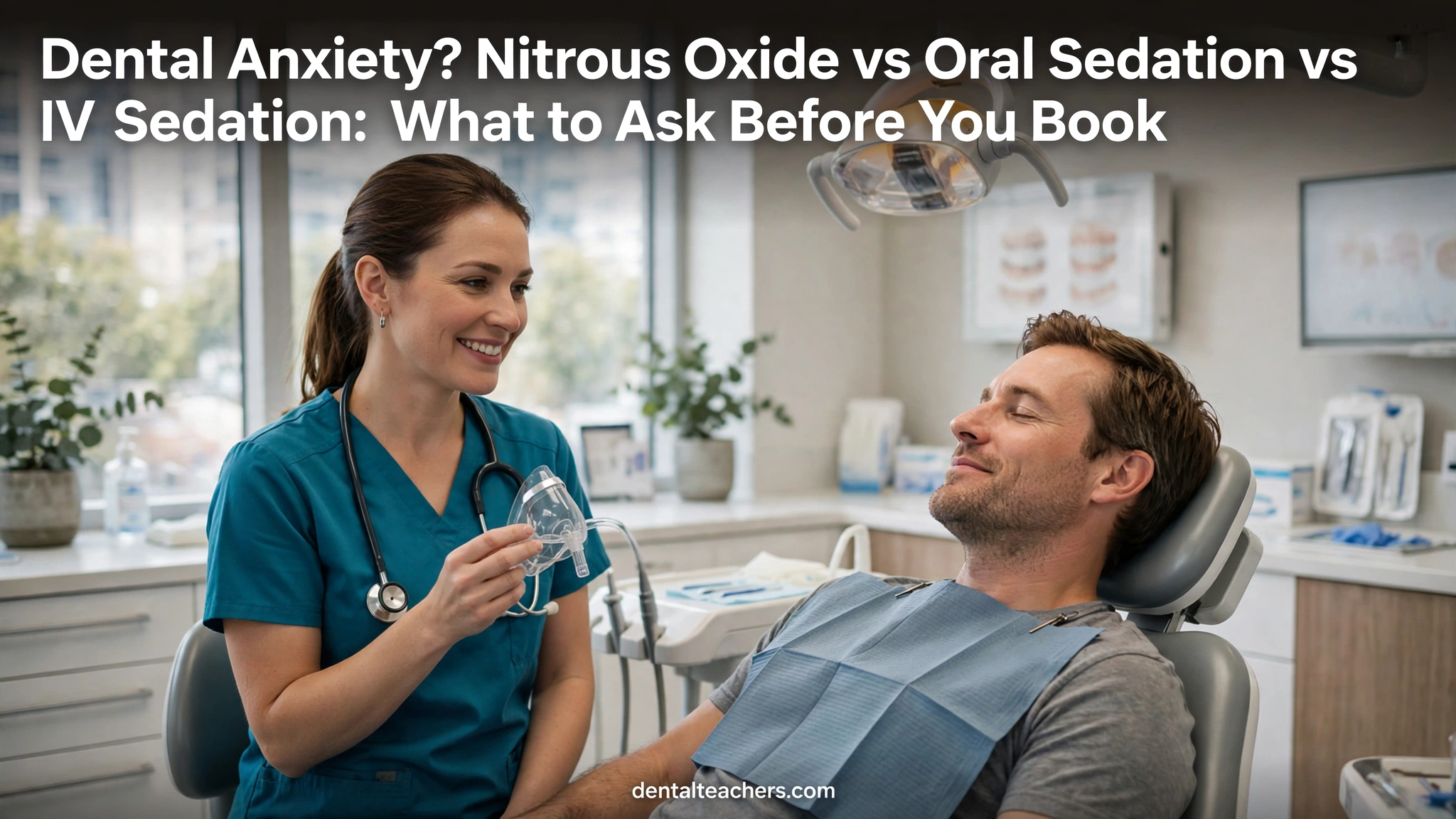

Dental anxiety is common, and it is also one of the main reasons people put off treatment until a small problem becomes a painful one. If the sound of the drill, the feeling of being unable to swallow, or a bad experience years ago is what keeps you out of the chair, sedation dentistry exists for exactly that. The question is not whether sedation helps. It is which level fits your anxiety, your procedure, and your health.
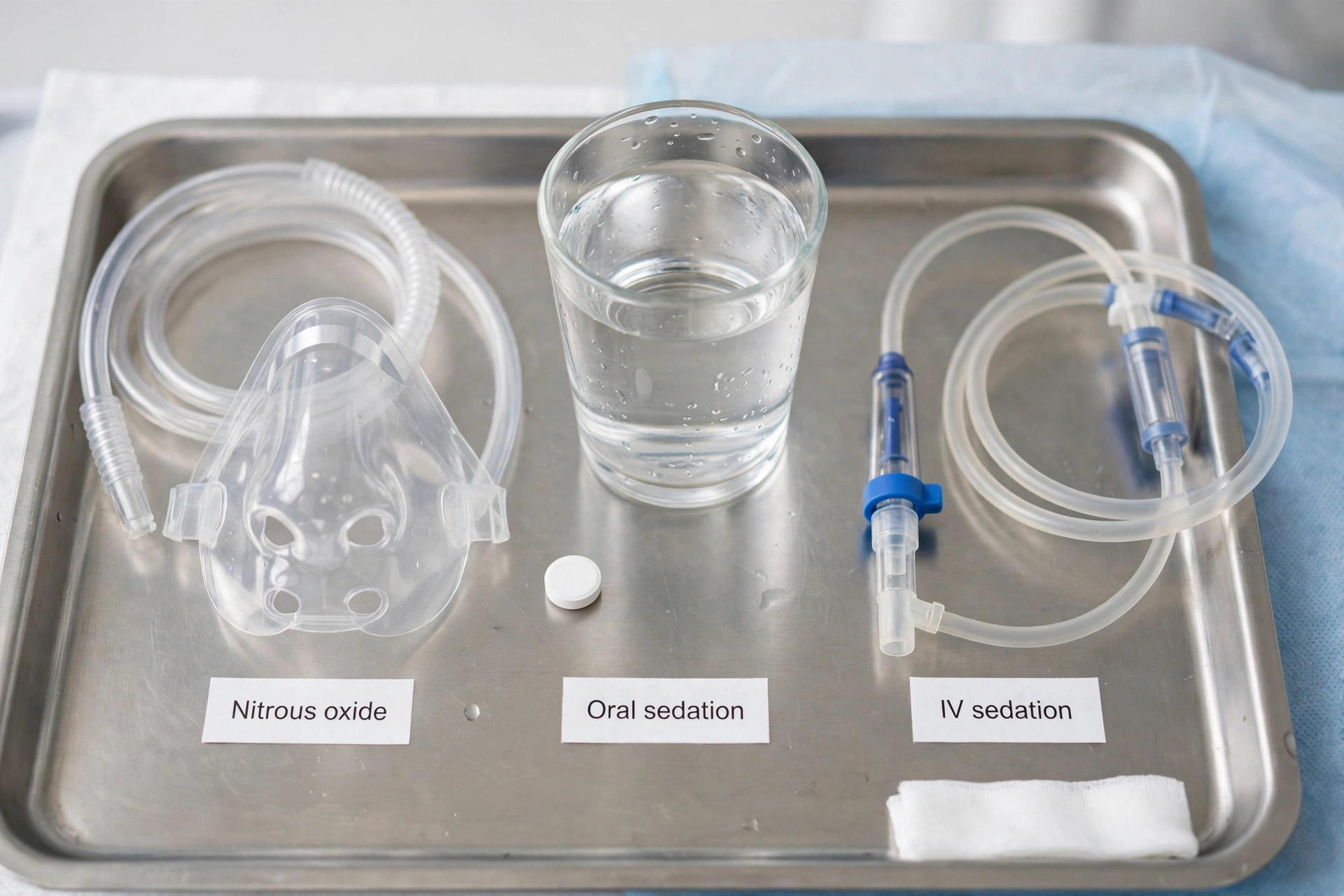
There are three levels most US dental offices offer for anxious patients: nitrous oxide (laughing gas), oral conscious sedation (a pill), and IV sedation (sedation through a vein). General anesthesia is a fourth, deeper level, but it is usually reserved for oral surgery and hospital settings, so this guide covers it only briefly.
The short answer: nitrous oxide is the lightest option and the only one after which you can usually drive yourself home. Oral sedation is a middle step for moderate anxiety, but you will need a driver and the rest of the day off. IV sedation is the deepest of the three, adjustable in real time, and the usual choice for severe anxiety or long procedures. Costs rise with depth, roughly $50-$150 for nitrous, $150-$500 for oral sedation, and $500-$1,500 or more for IV sedation per typical procedure. These are planning ranges, not quotes, and your dentist’s fee, your area, and the length of the procedure all move the number.
This guide is general education, not medical advice. If you have sleep apnea, a significant heart or lung condition, or you take medicines that affect breathing, talk to your own dentist and doctor before booking sedation.
The three levels at a glance
| Nitrous oxide | Oral sedation | IV sedation | |
|---|---|---|---|
| How it is given | Gas breathed through a small nose mask | A pill swallowed about 1 hour before | Medicine through a vein in your arm or hand |
| How awake are you? | Awake and relaxed, fully aware | Drowsy, awake but hazy, partial amnesia | Deeply relaxed, often asleep, little or no memory |
| Onset | 2-5 minutes | 30-60 minutes | Almost immediate |
| Can the dose be adjusted during treatment? | Yes, in real time | No, the dose is locked in once swallowed | Yes, in real time |
| Can you drive yourself home? | Usually yes, once the gas wears off | No, you need a driver | No, you need a driver |
| Recovery | 5-15 minutes after the gas stops | Groggy for 4-6 hours | Groggy for several hours |
| Typical cost (planning range) | $50-$150 per visit | $150-$500 per visit | $500-$1,500+ per procedure |
What each level costs in the USA in 2026
Prices vary by state, by office, and by how long the procedure runs. The ranges below converge across the consumer and clinic guides published in 2026, and they are planning ranges, not a quote for your visit.
| Level | Typical range | What usually moves the price |
|---|---|---|
| Nitrous oxide | $50-$150 per visit | Rarely varies much; some offices charge a flat fee per visit |
| Oral conscious sedation | $150-$500 per visit | The medicine itself and the extra monitoring time |
| IV sedation | $500-$1,500+ per procedure | Time-based, so a longer procedure costs more |
| General anesthesia (for reference only) | $1,000-$3,500+ per procedure | Hospital or surgical setting, anesthesiologist fees |
Two cost facts surprise most patients. First, dental insurance rarely pays for sedation unless it is medically necessary, and nitrous oxide is often excluded for adults entirely, so ask your plan before you assume coverage. Second, the sedation fee is separate from the procedure fee. A filling still costs what a filling costs; sedation is added on top.
Ask for the total in writing before you book: the procedure, the sedation level, and whether the sedation fee is per visit or per hour.
Nitrous oxide: the lightest option
Nitrous oxide, usually called laughing gas, is breathed in through a small mask over your nose while you stay fully awake. It takes effect in two to five minutes. You feel calm and a little detached, sometimes lightheaded or giggly, but you can still answer questions and follow instructions. When the dentist switches the mask back to plain oxygen, the feeling wears off in five to fifteen minutes.
It carries the lowest risk of the three levels. The most common side effects are brief nausea and lightheadedness. Dental systems maintain a minimum of 30% oxygen while nitrous is running, so you are never breathing pure gas. A light meal about two hours before your visit actually reduces the nausea, which is the opposite of the fasting rule for the deeper levels.
Nitrous has real limits. It may not be enough for severe phobia, and it is harder to use if you cannot breathe easily through your nose, for example with a bad cold or chronic congestion. It is the best first step if your anxiety is mild to moderate, if you want to drive yourself home, or if you are trying sedation for the first time.
Oral sedation: the middle step
Oral conscious sedation is usually a single pill, most often a benzodiazepine such as triazolam or lorazepam, taken about an hour before your appointment. You stay awake, but you feel drowsy and detached, and many people remember little or nothing of the procedure afterwards. That partial amnesia is one reason anxious patients like it.
The trade-off is control. Once you swallow the pill, the dose is locked in. It cannot safely be topped up in the middle of the procedure, and adding more medicine on top of a pill that is still absorbing carries a stacking risk. How strongly it works also varies more than the other levels, because absorption depends on your metabolism, your weight, and what is in your stomach. That is why oral sedation has a higher rate of under-sedation and over-sedation than nitrous or IV.
Plan for the whole day. You will feel groggy for four to six hours, and you must not drive, operate machinery, or drink alcohol for 24 hours. You need a driver to take you home, and you should not be alone for the rest of the day. Fasting rules apply: usually nothing to eat or drink for six to eight hours before, because of the aspiration risk if you become too drowsy.
Oral sedation suits moderate anxiety and shorter procedures, especially when you want to remember very little but do not need the depth or the cost of IV.
IV sedation: the deepest of the three
IV sedation is given through a vein, usually in your arm or hand. It works almost immediately, and because the medicine goes straight into the bloodstream, the dentist can adjust the depth in real time throughout the procedure. If you start to stir, more can be given; if you are deep enough, it can be eased off. That adjustability is the main reason it is the usual choice for severe anxiety, long procedures, and complex work such as multiple implants or wisdom tooth removal. Dental implants for seniors, including when sedation is used during implant surgery
Most patients drift into a sleep-like state and remember little or nothing. A study cited by Hillside Dental Care found IV sedation the fastest and most consistent of the levels for anxiety reduction, while oral midazolam was the slowest to take effect, over 12 minutes, and the most variable. That is one study’s finding, not a settled rule, but it matches why dentists reach for IV when predictability matters.
IV sedation needs the most preparation. You need a driver, you will be groggy for several hours, and the same 24-hour rule applies: no driving, no machinery, no alcohol. Fasting for six to eight hours beforehand is standard. The cost is time-based, so a two-hour procedure costs more than a forty-minute one, and the range of $500-$1,500 or more reflects that.
The risks, honestly
Sedation dentistry is routine and generally safe in healthy patients, but every level carries risk, and the risk rises with depth. The main risk at the deeper levels is slowed or shallow breathing, which is why your dentist monitors your oxygen, heart rate, and blood pressure throughout.
A few points matter more than the rest:
- Sedation is not numbing. Sedation reduces anxiety and awareness. Local anesthesia is what stops pain, and it is given separately. Being sedated does not mean you will not feel anything without numbing.
- Sleep apnea, heart conditions, and lung conditions need extra evaluation. If you use a CPAP machine, take heart or lung medicine, or have been told you stop breathing in your sleep, tell your dentist before booking. These do not automatically rule sedation out, but they change the plan and the monitoring. What science says about the link between oral health and heart disease
- Some medicines interact with sedatives. Bring a full list of everything you take, including over-the-counter medicines and supplements.
- Never take someone else’s sedative and never mix a sedative with alcohol unless your dentist specifically instructs it.
- Oral sedation’s locked dose is its main weakness. If it does not work enough, your dentist cannot simply add more mid-procedure.
Nitrous oxide avoids most of this: the lowest risk, the fastest recovery, and no driver needed. That is why it is the usual starting point.
Fasting, drivers, and recovery: the rules by level
| Rule | Nitrous oxide | Oral sedation | IV sedation |
|---|---|---|---|
| Eating before | A light meal about 2 hours before reduces nausea | Fast 6-8 hours (aspiration risk) | Fast 6-8 hours (aspiration risk) |
| Driver needed | Usually no | Yes | Yes |
| Time off afterwards | None, once the gas wears off | Rest of the day, groggy 4-6 hours | Rest of the day, groggy several hours |
| No driving, machinery, or alcohol | No restriction once recovered | 24 hours | 24 hours |
Arrange the driver before you book, not on the day. Offices will cancel or reschedule sedation appointments if you arrive without one, and you will usually still be charged.
What to ask before you book
Take this list to the consultation. A good office answers all of it plainly, and hesitation on any of these is a reason to ask more questions.
- Which level do you recommend for my anxiety and this procedure, and why?
- What is the total cost, including the sedation fee, and is it per visit or per hour?
- Will my insurance cover any of it, and will you check before the day?
- Who gives the sedation, and what training and permits do they hold?
- What monitoring do you use during sedation: oxygen, heart rate, blood pressure?
- What are my fasting instructions, exactly, and what time should I take the pill if it is oral sedation?
- Do I need a driver, and how long until I can drive and return to work?
- What happens if the sedation does not work enough: do we stop, reschedule, or switch levels?
- What should I tell you about my health: sleep apnea, heart or lung conditions, medicines, allergies?
- What is your emergency plan if my breathing slows or I react to the medicine?
If you have delayed treatment because of anxiety, say so at the first call. Dentists hear it every day, and it changes the plan in your favour. How early treatment of gum disease can save your smile
How the appointment usually goes
For nitrous, you arrive, sit in the chair, and breathe through the nose mask for a few minutes before anything starts. For oral sedation, you take the pill at home about an hour before and arrive already drowsy, with your driver. For IV, a small needle goes into a vein, the medicine starts, and you drift off within a minute or two. In all three cases the dentist still numbs the tooth, does the work, and then monitors you until you are steady enough to leave. Recovery rooms and a check before discharge are normal for oral and IV.
Modern offices also use quieter tools, slower pacing, and breaks on request, which help even without sedation. How digital dentistry is making dental treatment better
Frequently asked questions
Can I drive after nitrous oxide?
Usually yes. The gas wears off in five to fifteen minutes once the mask is switched to oxygen, and most patients drive themselves home. Your dentist will confirm you feel normal before you leave.
Will I be asleep during IV sedation?
Most patients are in a deep, sleep-like state and remember little or nothing. It is not the same as general anesthesia, and you can still be woken if needed.
Is sedation dentistry safe?
For healthy patients, yes, it is routine. The main risk is slowed breathing at deeper levels, which is why monitoring is used. Sleep apnea, heart or lung conditions, and certain medicines need extra evaluation first.
Does insurance cover sedation?
Rarely, unless it is medically necessary. Nitrous oxide is often excluded for adults. Ask your plan and your dentist’s office to check before the appointment.
What if oral sedation does not work enough?
Tell your dentist at the consultation if a pill has failed you before. Because the dose cannot safely be topped up mid-procedure, IV sedation is often the better choice in that case.
Can I eat before sedation?
For nitrous, a light meal about two hours before helps with nausea. For oral and IV sedation, fasting for six to eight hours is the standard rule because of aspiration risk. Follow your dentist’s exact instructions.
The bottom line
There is no single best sedation level, only the best one for your anxiety, your procedure, and your health. Nitrous oxide is light, cheap, and lets you drive home. Oral sedation is a middle step with partial amnesia, but the dose is locked in and you lose the day. IV sedation is the deepest and most adjustable, and the usual choice for severe anxiety or long work. Ask the ten questions above, get the total cost in writing, arrange your driver before you book, and tell your dentist about sleep apnea, heart or lung conditions, and every medicine you take. Anxiety is a reason to plan the visit properly, not a reason to skip it.