



A conventional denture is cheaper and faster. An implant-supported overdenture is steadier, stronger and kinder to the bone. That is the whole comparison in one sentence, and the rest of this guide is about the numbers behind it, because the gap between the two is not small. A conventional full denture costs about $1,500-$2,500 per arch in the USA in 2026. A 2-implant overdenture costs about $5,000-$12,000 per arch. The difference is surgery, months of healing, and a set of teeth that stays put when you eat and talk.
- The direct answer
- What it all costs, on one page
- A worked example: one lower arch
- Comfort and chewing, the seniors focus
- Bone loss over 5-10 years, and why the lower jaw matters most
- Daily care and maintenance
- Who should not get implants
- Medicare and insurance
- How to decide: four questions
- The bottom line
- Frequently asked questions
- How much do dentures cost for seniors in the USA in 2026?
- Are implant-supported dentures better than regular dentures?
- Does Medicare cover dentures or implant overdentures?
- How long do implant-supported overdentures last?
- Can I eat normally with an overdenture?
- What if I cannot have surgery for implants?
This guide is written for a patient in the USA, usually over 60, who has lost most or all of the teeth in one arch, or who already wears a denture that slips, and is deciding whether to stay with a conventional denture or to add implants underneath it. It explains what each option is, what each one costs per arch, what the difference buys you in comfort and chewing, what happens to the bone over 5-10 years, what daily care looks like, who should not get implants, what Medicare does and does not pay, and four questions that decide the choice.
One line to hold through the whole guide: the right choice is the one that fits the mouth, the hands and the budget, not the one with the better brochure. A denture that a person can clean, afford and wear every day beats an implant plan that cannot be finished or maintained.
The direct answer
A conventional full denture is a removable set of artificial teeth that rests on the gums. It is held in place by suction, by the shape of the ridge underneath it, and often by adhesive. There are no implants, no surgery, and no healing wait. It is made over several visits across a few weeks, and it costs about $1,500-$2,500 per arch for a standard denture, with a national average of about $2,022 in the CareCredit 2026 study. Economy dentures run $500-$1,200 per arch and premium ones $2,000-$3,600, but the standard band is the honest middle for most patients.
An implant-supported overdenture is the same idea with a foundation underneath it. Two to four small titanium implants are placed in the jawbone, they heal and bond to the bone over a few months, and the denture snaps onto them with locator or ball attachments. It is still removable, and it comes out every night for cleaning, but while it is in, it does not slip. A 2-implant overdenture costs about $5,000-$12,000 per arch all-in. A 4-implant overdenture costs about $10,000-$20,000 per arch. A bar-retained overdenture, where three or four implants are joined by a metal bar that the denture clips onto, costs about $10,000-$18,000 per arch.
Who each suits is simple. A conventional denture suits a person who wants the lowest cost, no surgery and the fastest result, and who can live with a denture that moves a little, especially on the lower jaw. An overdenture suits a person whose lower denture will not stay put, who wants to eat and speak without worrying about slipping, and who can have surgery, wait months for healing, and pay several times more. If the lower denture is the problem, and it usually is, a 2-implant overdenture is widely cited as the minimum standard of care for a loose lower denture, which means it is the first fix a dentist will usually suggest before anything more complex.
What it all costs, on one page
All figures below are per arch, not both arches, and all are typical US ranges for 2026, not quotes. Sources disagree on the exact edges, especially on the 2-implant low end, so the range is the honest figure. A single arch price is easily mistaken for a full-mouth price, so read every figure as one jaw, upper or lower.
| Treatment, per arch | Typical US range, 2026 | What it includes |
|---|---|---|
| Conventional full denture, standard | $1,500-$2,500, average about $2,022 | Denture, fittings, adjustments |
| Conventional denture, economy | $500-$1,200 | Basic denture, fewer fittings |
| Conventional denture, premium | $2,000-$3,600 | Better materials, more fittings |
| 2-implant snap-in overdenture, all-in | $5,000-$12,000 | 2 implants, surgery, attachments, denture |
| 4-implant overdenture, all-in | $10,000-$20,000 | 4 implants, surgery, attachments, denture |
| Bar-retained overdenture, 3-4 implants | $10,000-$18,000 | Implants, bar, clips, denture |
| All-on-4, fixed, contrast only | $15,000-$30,000 | Fixed full arch, not a removable overdenture |
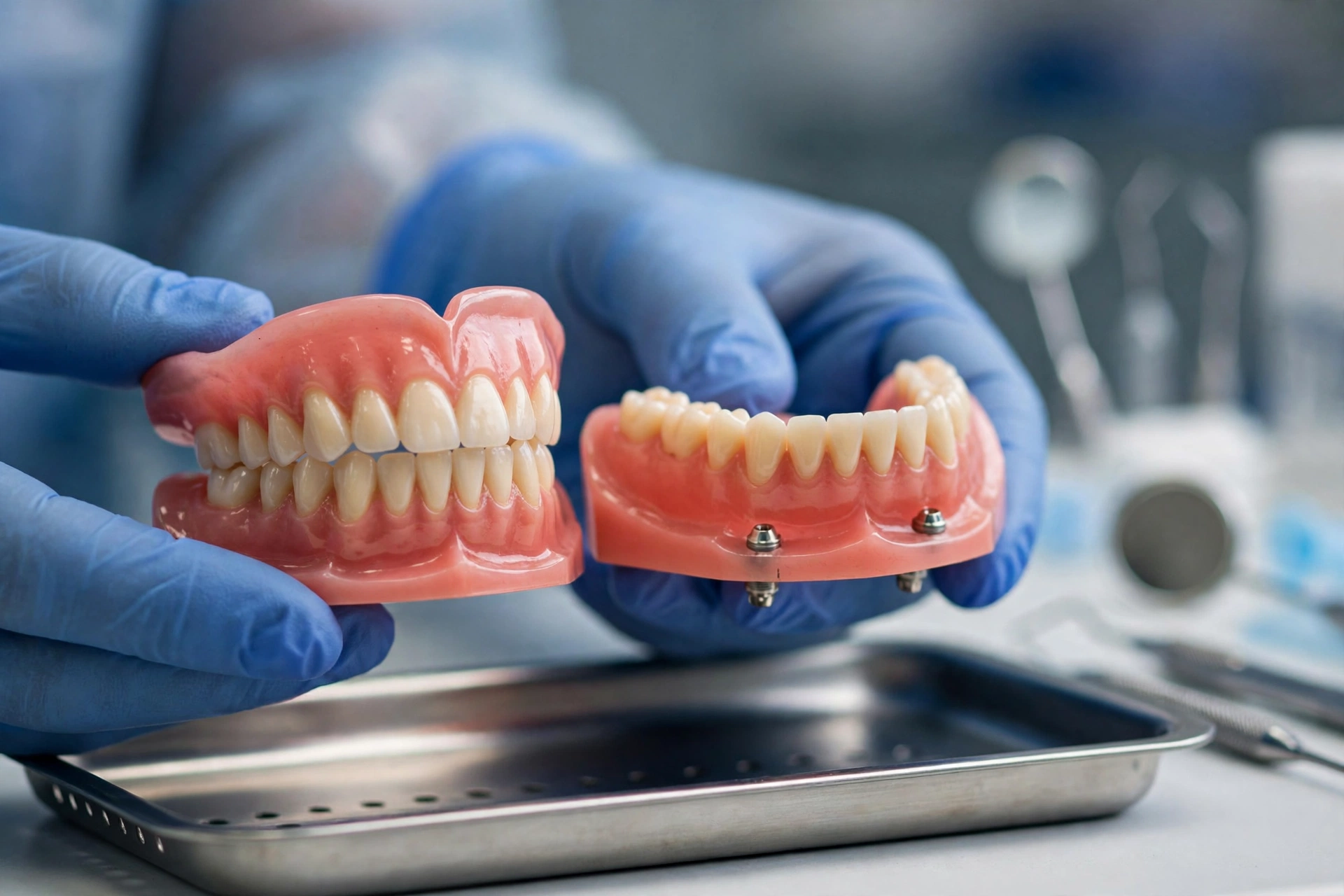
The implants themselves cost about $1,500-$3,000 each including surgery, and the overdenture fabrication adds about $2,500-$6,000 on top. That is why the total jumps so far above a conventional denture: the price is mostly the surgery and the implants, not the plastic teeth. Both arches with snap-in overdentures run about $12,000-$30,000 or more, which is the figure to keep in mind if both jaws need treatment, because a per-arch quote of $5,000 can become $10,000 before the work is done.
All-on-4 is shown only for contrast. It is a fixed full arch, screwed onto four implants, and it does not come out at night, so it is not an overdenture. It costs about $15,000-$30,000 per arch. If a clinic quotes All-on-4 as an overdenture, that is a sign to ask exactly what is being sold, because the two treatments are different in cost, in care and in what happens if something goes wrong.
A worked example: one lower arch
Take one lower arch, which is where most of the trouble is, because the lower denture has the least to hold onto. A conventional lower denture costs about $2,022, the CareCredit 2026 national average. A 2-implant overdenture for the same lower arch costs $5,000-$12,000 all-in. The difference is roughly $3,000-$10,000 for the lower arch alone, before insurance.
What that difference buys is stability, not teeth. The teeth in both options look similar. The difference is that the conventional denture rests on the gum and moves when the tongue moves beside it, while the overdenture snaps onto two implants and stays where it was put. For a person whose lower denture lifts every time they eat, that difference is worth more than the money. For a person whose conventional denture already fits well and stays put, the same money buys almost nothing, and the conventional denture is the better spend.
The example is illustrative, not a quote. Your own figure depends on how many implants are needed, whether a bone graft is needed first, whether the denture is new or an existing one being converted, and what your plan pays. Ask for the quote per arch, in writing, with the implant count, the attachment type and the denture cost shown as separate lines, so you can see what each part costs before you agree to any of it.
Comfort and chewing, the seniors focus
Comfort is where the two options part company most clearly, and chewing is where it shows. A conventional denture gives about 20-30 percent of natural biting force, which means a person wearing one chews with roughly a quarter of the force they had with natural teeth. Some guides put the loss the other way round, that denture wearers lose about 75-80 percent of natural chewing force, which is the same picture from the other side. Hard foods, apples, raw carrots, steak, nuts, become work, and many people quietly stop eating them, which is a diet problem as much as a dental one.
An overdenture does not restore full natural force, and no removable option does, but it improves chewing significantly against a conventional denture, because the teeth stay in place while the jaw works. Food that needs a firm bite becomes possible again, and slipping during speech largely disappears, which matters as much as eating. A denture that moves when you talk makes a person speak less, and speaking less is a social cost, not only a dental one.
The lower jaw is where the difference is biggest, and it is also where a conventional denture is weakest. The lower ridge is narrow, the tongue sits beside it and moves against it with every word and every swallow, and there is no palate to help with suction the way the upper denture has. That is why the lower denture is the one that lifts, rocks and sore-spots, and why a 2-implant overdenture is widely cited as the minimum standard of care for a loose lower denture. Two implants on the lower jaw change the whole experience, because they give the denture something to hold onto that the tongue cannot push away. The upper denture, by contrast, often fits well enough on suction alone, and many people who need implants need them on the lower arch first, and sometimes only there.
Sore spots are the other comfort question. A conventional denture rests on soft gum, and any uneven pressure makes a sore spot, which is why adjustments are part of the first weeks. An overdenture spreads the load onto the implants as well as the gum, so sore spots are less common, but the attachments themselves need care, and a worn attachment that lets the denture rock will make its own sore spots. Neither option is fit and forget. Both need a dentist who adjusts them, and the overdenture needs one who also checks the implants.
Bone loss over 5-10 years, and why the lower jaw matters most
A tooth root does more than hold a tooth. Every time you bite, the root passes pressure into the jawbone, and that pressure tells the bone to keep renewing itself. Take the teeth away and the signal stops, and the bone slowly breaks down and carries itself away. A conventional denture does nothing to stop this, because it rests on top of the gum and presses on the ridge, and the ridge resorbs underneath it over 5-10 years. The fit loosens, the denture needs relining, and eventually it needs remaking, because the mouth it was made for no longer exists.
Implants change this, because they put pressure back into the bone. An implant bonds to the bone, a process called osseointegration, and every bite passes force through it into the jaw, which slows the resorption where the implant sits. It does not stop bone loss everywhere, and it does not rebuild bone that is already gone, but it preserves what is there far better than a denture alone. The difference over a decade is real: a person with an overdenture usually keeps more ridge height and a better-fitting denture for longer than a person with a conventional denture, and the denture needs remaking less often.
The lower jaw matters most here for the same reason it matters for comfort. The lower ridge is narrower to begin with, it resorbs faster, and once it is flat there is almost nothing for a conventional denture to grip. A lower denture on a flat ridge is the hardest denture to wear, and it is the case where two implants make the biggest difference, because they give a flat ridge something to hold onto. If bone is already badly lost, a graft may be needed before implants can be placed, and that adds cost and months. Our guide to bone loss, grafts and sinus lifts explains when that is needed and what it costs: Dental Implants After Bone Loss: Bone Graft, Sinus Lift, and When Implants Are Not Possible
The lifespan figures follow from the same biology. A conventional denture lasts about 5-8 years before it needs replacing, with relines every 1-2 years as the ridge changes underneath it. An overdenture lasts about 10-15 years, and the implants themselves can last a lifetime with maintenance, while the denture part is replaced when it wears. Cleveland Clinic advises replacing an overdenture every 15-20 years for best results, which is a longer horizon than a conventional denture offers, but it is still a replacement, not a permanent fixture.
Daily care and maintenance
Daily care is the part of the decision that is easiest to get wrong, because both options look simple from the outside and both have a routine that has to be kept for years.
A conventional denture comes out at night. It is brushed, rinsed and soaked in a denture solution overnight, and the gums are brushed and rinsed too. Adhesive is applied daily, and the denture is cleaned after meals when food gets underneath it. The routine is cheap and simple, and it can be done by hand, but it has to be done every day, and a denture left in overnight, or cleaned badly, grows fungus and smells, and the gum underneath it gets sore and infected. Relines are needed every 1-2 years as the ridge resorbs, and the denture itself is replaced every 5-8 years.
An overdenture comes out at night too. The denture is cleaned the same way, but the implants and abutments, the small posts the denture snaps onto, also need cleaning every day, with a brush or an interdental brush around each post, because plaque around an implant causes the same gum disease that natural teeth get, and an implant with infected gum around it can fail. The attachment inserts, the small nylon or rubber rings inside the denture that grip the posts, wear out with use and need replacing, usually every 6-12 months, and a worn insert lets the denture rock, which is the first sign it needs changing. The denture part lasts 10-15 years, and the implants can last a lifetime with maintenance, but that maintenance is a daily habit and a regular dental visit, not a one-time payment.
For a person whose hands are stiff, whose eyesight is poor, or who cannot manage small cleaning tools, the simpler routine matters more than the better denture. A conventional denture is easier to clean than an overdenture with posts and inserts, and a person who cannot clean around implants should not have them. Ask honestly, before choosing, whether the daily cleaning can be done, every day, for years, and whether someone will help if it cannot. The best denture is the one that gets cleaned.
Who should not get implants
Most people who are told they do not have enough bone can still have implants, by grafting or by a different design, but some people should not have them at all, or should wait, and the reasons are mostly about healing, not about bone alone.
Uncontrolled diabetes is the first. High blood sugar slows healing and raises infection risk, and implants placed while A1C is uncontrolled fail more often. The fix is usually medical, not dental: bring the A1C down with your doctor first, then re-plan.
Heavy smoking is the second. Smoking cuts blood flow to the gum and bone, and it roughly doubles implant failure rates. Many surgeons ask patients to stop completely for at least a few weeks before and after surgery, and some will not place implants at all for a patient who will not stop. This is not a judgement. It is a healing fact, and it is worth hearing plainly before you pay for a graft.
Certain medicines are the third. IV bisphosphonates, strong bone drugs given by infusion for cancer or severe osteoporosis, can cause a rare but serious condition where jawbone dies after surgery, and implant surgery is usually avoided while a patient is on them. Oral bisphosphonate tablets for ordinary osteoporosis are a different, lower-risk picture, and many patients on them do have implants, with their doctor and dentist deciding together. Blood thinners, steroids and some cancer medicines also change the plan, and every medicine should be on the table at the first consultation, not discovered at surgery.
Head and neck radiation is the fourth. Radiation to the jaw damages the bone’s blood supply for life, and implants in radiated bone need a specialist centre, sometimes with hyperbaric oxygen treatment first.
Surgery tolerance is the fifth, and it is the one that matters most for older patients. Implants need minor oral surgery, local anaesthesia, and months of healing, and a person who cannot tolerate surgery, or who cannot sit through it, should not have it. A conventional denture needs no surgery at all, and for a frail patient that alone can decide the choice.
If implants are not possible, the honest alternatives are a conventional denture, which is the subject of this guide, or a fixed bridge, which needs healthy neighbouring teeth and does not stop bone loss underneath it. And if the problem is one bad tooth rather than a whole arch, the question may not be denture or implant at all, but whether the tooth can be saved. Our comparison of the two paths works through that decision: Root Canal vs Extraction and Implant: Cost, Pain, and How to Decide in 2026
Medicare and insurance
Original Medicare generally does not cover dentures, partials or implants, under the Social Security Act 1862(a)(12), which excludes most routine dental care. There are narrow exceptions only when dental work is needed for the success of a covered medical treatment, such as jaw surgery after an accident, and a denture for missing teeth does not meet them. That is the position for most seniors, and it is why the cost in this guide is usually paid out of pocket, or through a separate dental plan, not through Medicare.
Medicare Advantage plans may include a denture benefit, usually with an annual maximum around $1,000-$3,000 and often 50 percent coinsurance, which means the plan pays half up to the maximum and the patient pays the rest. Implants are rarely covered under these plans, and when they are, the same maximum caps the payment, so a $5,000 overdenture with a $1,000 maximum leaves $4,000 to the patient. No expansion of Medicare dental coverage is expected in 2026, so a reader planning on a change should not wait for one.
Standalone dental plans are the third route, and they are the ones with the fine print that matters most. Many impose a waiting period of 6-12 months on major work, including dentures and implants, and many exclude implants outright, or cover them only as major work up to the annual maximum. Our guide to reading the fine print covers the traps in detail, including the missing tooth clause, which can deny a claim for a tooth lost before the plan started: Dental Insurance With No Waiting Period for Implants in the USA: How to Read the Fine Print Before you commit to either path, ask your plan for the code, the benefit category and the remaining annual maximum in writing, and do not rely on a percentage alone.
For older patients, the same maths meets a different question, whether an implant is the right spend at all, and our seniors guide works through it: Dental Implants for Seniors Over 65 in the USA in 2026: Medicare, Costs, and Safer Alternatives
How to decide: four questions
Take these four questions to your consultation. The answers, not the brochure, are the plan.
- How do I chew now, and what do I want to eat? If a conventional denture already lets you eat what you want, the extra money buys little. If you have stopped eating hard foods, or you avoid eating with other people because the denture moves, an overdenture is worth its price.
- Can I clean it, every day, for years? A conventional denture is simpler to clean. An overdenture needs cleaning around the implants and the posts as well as the denture, and the inserts need replacing. If the hands or the eyesight will not manage it, choose the simpler routine.
- Can I have surgery, and can I wait months? Implants need minor surgery and 3-6 months of healing before the final denture, and a graft adds more time. If surgery is not possible, or the wait is not acceptable, a conventional denture is the right answer, and it is ready in weeks.
- What is the full cost, per arch, after insurance, including everything? Ask for an itemised quote with the implant count, the attachment type, the denture cost, the graft if needed, and the scan and sedation shown as separate lines, and get a written predetermination of benefits before any work starts. A quote that leaves any of those out is not a complete quote.
If a clinic cannot answer the fourth question in writing, get a second opinion before you pay for anything. The quote is the plan.
The bottom line
A conventional denture costs about $1,500-$2,500 per arch, needs no surgery, and is ready in weeks, but it gives about 20-30 percent of natural biting force, it slips, especially on the lower jaw, and the bone underneath it keeps shrinking, so it needs relining every 1-2 years and replacing every 5-8 years. A 2-implant overdenture costs about $5,000-$12,000 per arch, needs surgery and months of healing, but it stays put, it chews better, it preserves more bone, and it lasts about 10-15 years, with the implants able to last a lifetime with maintenance. The difference is roughly $3,000-$10,000 for one lower arch, and what it buys is stability, not teeth.
So ask the four questions, get the quote in writing, and let the mouth, the hands and the budget decide. Stay with a conventional denture when it fits well, when surgery is not possible, or when the budget will not stretch. Add implants when the lower denture will not stay put, when eating and speaking have become a worry, and when the daily cleaning can be kept up for years. The goal is not the cheaper treatment or the newer one. It is the set of teeth that is still working, still fitting, and still being worn, five years from now.
Frequently asked questions
How much do dentures cost for seniors in the USA in 2026?
A conventional full denture costs about $1,500-$2,500 per arch for a standard denture, with a national average of about $2,022 in the CareCredit 2026 study. Economy dentures run $500-$1,200 per arch and premium ones $2,000-$3,600. A 2-implant overdenture costs about $5,000-$12,000 per arch all-in, and a 4-implant overdenture about $10,000-$20,000 per arch. All figures are per arch, not both arches, and they are typical US ranges, not quotes.
Are implant-supported dentures better than regular dentures?
For stability and chewing, yes. An overdenture snaps onto implants and stays put while you eat and talk, while a conventional denture rests on the gum and moves, especially on the lower jaw. An overdenture also preserves more bone, because the implants put pressure back into the jaw. But it costs several times more, needs surgery and months of healing, and needs daily cleaning around the implants. For a person whose conventional denture already fits well, the extra money buys almost nothing.
Does Medicare cover dentures or implant overdentures?
Original Medicare generally does not cover dentures, partials or implants, under the Social Security Act 1862(a)(12), with only narrow exceptions when dental work is needed for the success of a covered medical treatment. Medicare Advantage plans may include a denture benefit, usually with an annual maximum around $1,000-$3,000 and often 50 percent coinsurance, and implants are rarely covered. Ask your plan for the code, the benefit category and the remaining maximum in writing before you decide.
How long do implant-supported overdentures last?
The denture part lasts about 10-15 years, and Cleveland Clinic advises replacing an overdenture every 15-20 years for best results. The implants themselves can last a lifetime with maintenance, which means daily cleaning around the posts and regular dental visits. A conventional denture lasts about 5-8 years, with relines every 1-2 years as the ridge resorbs underneath it.
Can I eat normally with an overdenture?
Better than with a conventional denture, but not like natural teeth. An overdenture improves chewing significantly, because the teeth stay in place while the jaw works, and hard foods that a conventional denture cannot manage often become possible again. It does not restore full natural biting force, and no removable option does, so some foods will still need care, and the denture still comes out at night.
What if I cannot have surgery for implants?
Then a conventional denture is the right answer, and it is a good one. It needs no surgery, it is ready in weeks, and it costs about $1,500-$2,500 per arch. Adhesive, regular adjustments and relines every 1-2 years keep it working, and it should be replaced every 5-8 years as the ridge changes. If the lower denture is the problem and surgery is not possible, a well-made conventional denture with adhesive is the best available option, and a dentist who says so is being honest, not unhelpful.
This article is general information, not medical advice and not insurance advice. Dental plan terms vary by state and change every year. The policy document is the only binding source of what a plan covers. Get a written plan, with codes and prices, before you decide, and discuss the treatment, including any pain, swelling or jaw symptoms, with your dentist.


