



Your dentist has found a badly damaged or infected tooth and says there are two ways forward: a root canal to keep it, or taking it out and placing an implant. The next question is which one, and the answer is not the same for every tooth. The short answer is that if the tooth can be saved predictably, a root canal plus crown is usually cheaper and faster, about $1,400-$4,500 all-in, and lasts about as long as an implant at 6 years. If the tooth cannot be saved, extraction plus implant costs about $3,250-$6,400 all-in and takes months.
This guide is written for a patient in the USA who has been told a tooth is badly damaged or infected and must choose between these two paths. It explains what actually happens in each option, what each one costs in 2026, how long each one lasts, when a root canal is the right call and when it is the wrong call, what extraction plus implant really involves, what insurance will and will not pay, and a checklist of six questions to ask your dentist before you decide.
One line to hold through the whole guide: where a tooth can be predictably restored, root canal treatment is the first choice. An implant is the replacement for a tooth that cannot be kept, not an upgrade on one that can. The comparison is only a real choice when the tooth’s long-term outlook is uncertain, and that is a question only an examination and X-rays can answer.
The short answer
A root canal cleans the inside of the tooth, seals it, and usually ends with a crown. It keeps your own tooth, it usually takes 1-2 visits, and all-in it costs about $1,400-$4,500 in the USA in 2026, before insurance. An extraction plus implant removes the tooth, waits for healing, places a titanium post in the jawbone, waits again for the bone to bond to it, and then fits a crown. It replaces the tooth entirely, it takes 3-9 months from extraction to final crown in most cases, and all-in it costs about $3,250-$6,400, before insurance.
At 6 years and beyond, the best systematic review of 143 studies found weighted survival of about 97 percent for a root canal tooth with proper restoration and about 97 percent for an implant-supported single crown. At that horizon, the two are about equal. A large 2026 Swedish national cohort found a bigger gap at 9 years, 83.4 percent survival for root canal therapy against 97.9 percent for implants, but that study was not randomised, so the patients who got each treatment were different to begin with, and the result cannot be read as a head-to-head trial. The honest picture is that both treatments work well when they are the right choice for the tooth, and both fail more often when they are the wrong choice.
TL;DR: the two paths at a glance
| Root canal plus crown | Extraction plus implant | |
|---|---|---|
| What stays | Your own tooth, cleaned and crowned | Nothing of the tooth; a titanium post replaces the root |
| Typical cost in 2026, before insurance | About $1,400-$4,500 all-in | About $3,250-$6,400 all-in |
| Time from start to finish | 1-2 visits, usually 1-3 weeks | 3-9 months, in stages |
| Pain afterwards | Soreness usually 2-3 days | Soreness a few days, with swelling after surgery |
| How long it lasts | Typically 10-15 years, often decades if it survives the first 5 years | Typically 15-25 years with good care, but not maintenance free |
| Best when | Enough sound tooth remains, root not fractured, gum and bone healthy | Tooth cannot be predictably restored, or is already gone |
The one-line rule: save the tooth when it can be predictably restored. Replace it when it cannot.
What actually happens in each option?
A root canal, properly called root canal treatment or endodontic treatment, is done when the pulp inside a tooth becomes inflamed, infected or non-vital. The dentist numbs the area, makes a small opening in the top of the tooth, removes the inflamed or infected pulp from the pulp chamber and the canals inside each root, cleans and shapes the canals, and seals them with a rubber-like material called gutta-percha. The tooth stays in its socket, held by the ligament and bone around the root, so it still feels pressure when you bite. Because a root canal treated back tooth can become more brittle, it usually needs a crown or onlay afterwards. Front teeth sometimes need only a filling, if enough tooth remains. Most root canals take 1-2 visits.
An extraction plus implant is two treatments in sequence. First the tooth is taken out, under local anaesthesia, sometimes with sedation. A simple extraction uses forceps. A surgical extraction cuts into the gum and may remove some bone around the tooth. Then the socket heals, which takes weeks to a few months. If there is not enough bone, a bone graft is placed, which adds cost and time. Then the implant, a small titanium or ceramic post, is placed in the jawbone, and over the following months the bone bonds directly to its surface, a process called osseointegration. A connector called an abutment is then attached, and a crown is fitted on top. Some people can have an implant placed immediately after extraction, but many need to wait 1-4 months or longer for proper bone healing, and the whole path from extraction to final crown takes 3-9 months in most cases.
Pain is the question most patients ask first, and the honest answer is less frightening than the reputation. Modern root canal pain, once the tooth is numb, is usually comparable to a filling, and most soreness afterwards lasts 2-3 days. Extraction soreness is similar, and implant surgery soreness lasts a few days, with swelling that peaks at 2-3 days and then fades. The pain that brings most people to the dentist, the infection itself, is usually worse than either treatment. If you feel anxious about dental visits, that is a separate question from which treatment to choose, and it is worth raising with your dentist before the day, not on it.
What does each option cost in the USA in 2026?
The price depends on the tooth, the provider, the region and your insurance. Here are the typical US ranges, with what each band includes and excludes. All figures are before insurance, and none of them is a quote.
| Option | Typical cost in 2026 | What it includes | What it excludes | CDT codes |
|---|---|---|---|---|
| Root canal, front tooth | $700-$1,100, average about $905 | Cleaning and sealing the canals | Crown or filling afterwards, X-rays, exam | D3310 |
| Root canal, premolar | $800-$1,300, average about $1,023 | Cleaning and sealing the canals | Crown or filling afterwards, X-rays, exam | D3320 |
| Root canal, molar | $1,000-$1,600, average about $1,220 | Cleaning and sealing the canals | Crown or filling afterwards, X-rays, exam | D3330 |
| Crown after a root canal | $1,000-$2,500, porcelain average $1,399 | The crown itself | Root canal, core build-up, post | Per material |
| Root canal plus crown, all-in | Commonly $1,400-$4,500 | Root canal and crown | Exam, X-rays, build-up, sedation | D3310-D3330 plus crown |
| Simple extraction | $130-$500, average about $177-$250 | Removing the tooth | Replacement, bone graft, sedation | D7140 |
| Surgical extraction | $250-$650, average about $363 | Removing the tooth, cutting gum and bone if needed | Replacement, bone graft, sedation | Surgical |
| Single implant, all-in | $3,000-$6,000, average about $4,500 | Post, abutment and crown | Bone graft $300-$1,400, 3D scan, extraction, sedation | D6010 plus abutment and crown |
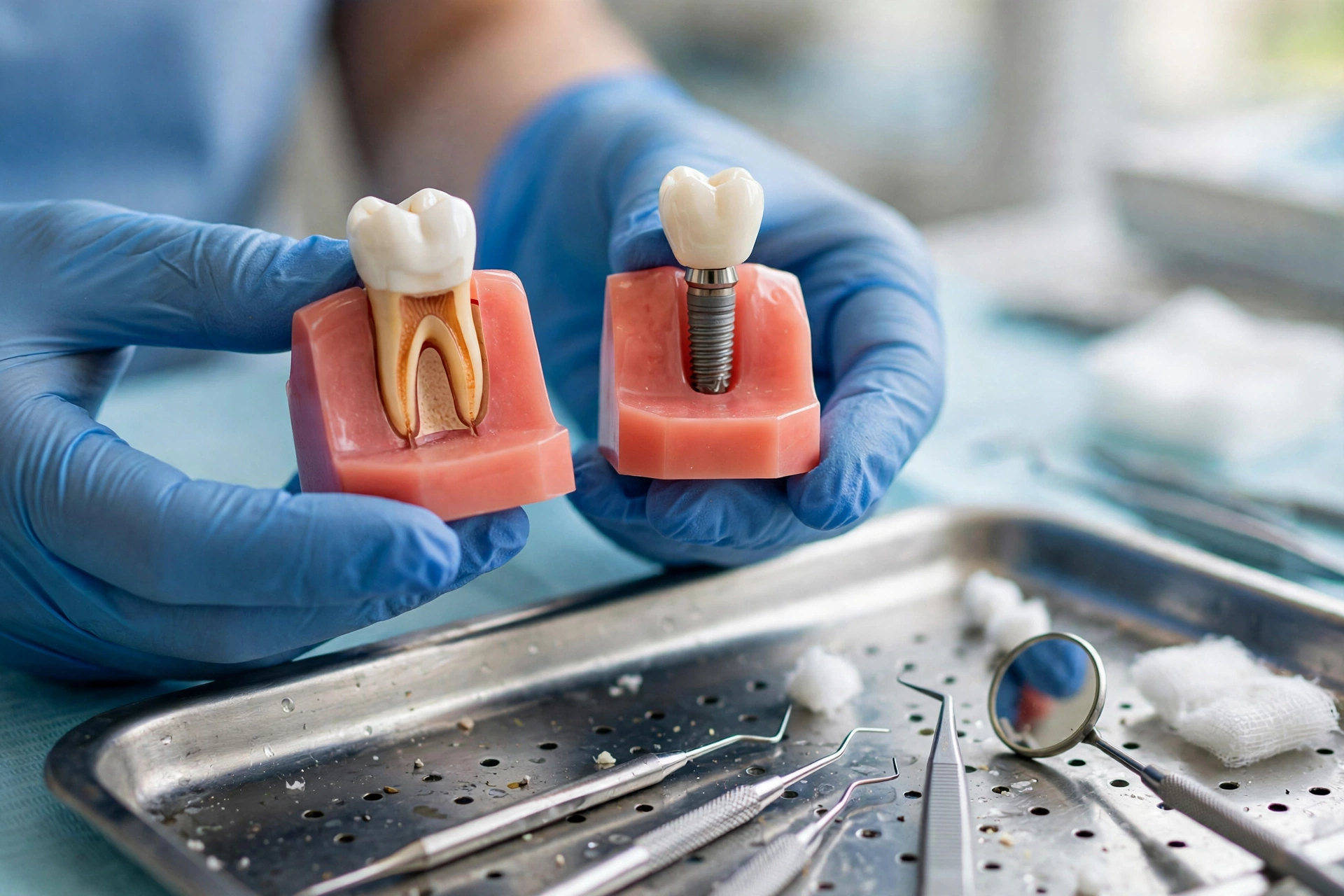
The averages come from the CareCredit 2026 Synchrony Average Procedural Cost Study (Sep 2026), which gives $905 for a front tooth, $1,023 for a premolar and $1,220 for a molar, and $1,399 for a porcelain crown from its Nov 2024 survey. Delta Dental’s out-of-network figures are higher, about $1,200 for a front tooth, $1,300 for a premolar and $1,500 for a molar. The wider national range for a root canal is $685-$1,800 per tooth, with an average of about $1,050. The implant post alone, CDT D6010, averages about $3,075, with a range of $2,005-$5,255, and the abutment and crown bring the all-in total to $3,000-$6,000. Delta Dental puts a single implant at $2,800-$5,600 without benefits.
Here is the worked example, with illustrative figures, not a quote. A molar root canal at $1,220 plus a porcelain crown at $1,399 comes to about $2,619 all-in. An extraction at $250-$400 plus a single implant at $3,000-$6,000 comes to about $3,250-$6,400 all-in. The implant path costs roughly $600-$3,800 more than the root canal path for the same tooth, before insurance, and it takes months longer. That gap is the price of replacing a tooth rather than saving it, and it is worth paying only when the tooth cannot be saved predictably.
The cost picture for implants, including what Medicare does and does not pay, is in our seniors guide: Dental Implants for Seniors Over 65 in the USA in 2026. The figures there and the figures here are the same ranges, because the implant is the same treatment whether the tooth was lost to decay, to a fracture, or to old age.
How long does each option last?
This is where the comparison needs care, because the numbers that get quoted are not all measuring the same thing. Success is defined differently for each treatment, so headline success numbers are not directly comparable. A root canal is called a success when the tooth is free of infection and still working. An implant is called a success when the post is stable, the bone is healthy, and the crown is working. Survival is the cleaner comparison: is the tooth, or the implant, still there and still working after a given number of years.
At 6 years and beyond, the large systematic review by Torabinejad and colleagues, covering 143 studies, found weighted survival of about 97 percent for root canal treatment with proper restoration and about 97 percent for an implant-supported single crown, against about 82 percent for a fixed bridge. At that horizon, saving the tooth and replacing it are about equal, and both are better than a bridge.
At 4 or more years, an umbrella review published in Nov 2026 in Odontology (PMID 43002373) indirectly pooled survival at about 92-94 percent for endodontically treated teeth and about 94-97 percent for implant-supported crowns. The review warns that these are not direct comparisons, because the studies pooled were not comparing the two treatments in the same patients. The review’s own conclusion is that preservation should be considered when a long-term favourable prognosis is achievable.
The newest large study, a 2026 Swedish national cohort in the Journal of Dentistry (PMID 42641863), followed 10,654 root canal cases and 5,327 implant cases, diagnosed in 2015-2016 and followed to 2023. At 9 years, survival was 83.4 percent for root canal therapy and 97.9 percent for implants, mean function time was 5.8 years against 6.6 years, and mean cumulative costs were USD 1,243 against USD 2,667. That looks like a clear win for implants, but the limits matter. Treatment was not randomly assigned, so the patients who got each treatment were different to begin with, and selection bias is possible. The study also found an exception: at mandibular anterior sites, the lower front teeth, root canal treatment did better at lower cost. The study’s message is not that implants always win. It is that the answer depends on the tooth.
In plain words, a properly crowned root canal tooth typically lasts 10-15 years, and a root canal tooth that survives the first 5 years has an excellent chance of lasting decades. An implant typically lasts 15-25 years with good care, but it is not maintenance free. Peri-implantitis, inflammation and bone loss around an implant, affects about 22 percent of implants on average in one systematic review, and it needs treatment of its own. An implant has no ligament to absorb force the way a natural tooth does, so heavy grinding wears it differently, and a crowned root canal tooth that is ground at night needs the same protection as any other tooth. Our guide to night guard costs explains the options: Night Guard Cost in the USA in 2026: Dentist vs Online vs Drugstore.
When is a root canal the right call, and when is it the wrong call?
Save the tooth with a root canal when enough sound tooth remains above the bone to hold a crown, when the root is not fractured, when the gum and bone around the tooth are healthy, and when the infection can be cleaned out. That is the common case for a tooth with deep decay or a large filling that has reached the pulp. The American Association of Endodontists’ position is that restorability, aesthetics and the cost-to-benefit ratio decide, and that saving a restorable tooth is generally preferred, because keeping your own tooth preserves the ligament, the bone and the feeling of the bite, and it can delay or remove the need for an implant later.
Do not save the tooth when there is a vertical root fracture, which is a crack running down the root that cannot be sealed, when too little tooth is left above the bone to hold a crown, when there is advanced bone loss around the root, or when the infection keeps coming back after treatment. A root canal on a tooth with a cracked root will fail, and the money spent on it will have been wasted. A dentist can often see a crack on an X-ray, and a 3D scan, called CBCT, can show cracks and root shapes that a flat X-ray misses. If your dentist suggests a CBCT before deciding, that is a sign the decision is genuinely uncertain, not a sign of upselling.
Age and health matter too, but not in the way people expect. There is no age limit on a root canal, and older patients often do better keeping a tooth than going through implant surgery. What matters is the bone, the gum, the bite, and whether you can keep the tooth clean. A tooth that cannot be kept clean will fail whatever treatment you choose.
What does extraction plus implant really involve?
Extraction plus implant is a longer path, and the time is the part most people underestimate. It starts with the extraction, which is one visit. Then the socket heals, which takes weeks to a few months. If there is not enough bone to hold an implant, a bone graft is placed, which costs $300-$1,400 and adds months of healing. Then the implant post is placed in the jawbone, which is a surgical visit, and over the following months the bone bonds to it. Then the abutment is attached, an impression is taken, and the crown is fitted. From extraction to final crown, the path takes 3-9 months in most cases.
During that time there is a gap in your mouth. A temporary tooth can fill it, usually a flipper or a temporary bridge, but that is another cost and another appointment, and it is not as strong as a real tooth. Eating on that side is limited while healing, and the implant site needs careful cleaning. The visits add up: extraction, graft check, implant placement, healing checks, abutment, impression, crown fitting, and follow-up. A root canal path is usually 1-2 visits plus a crown appointment.
None of this is a reason to avoid an implant when it is needed. It is a reason to count the time and the visits in the decision, not only the money. An implant is the right treatment for a tooth that is already gone, or that cannot be saved. It is a poor trade for a tooth that could have been saved in two visits.
What will insurance pay?
Root canal treatment and extraction are commonly covered as basic or major work at 50-80 percent after the deductible, subject to the annual maximum. A root canal on a molar at $1,220, covered at 50 percent after a deductible, leaves you paying about $610 plus the deductible, if the annual maximum has room. The crown is usually covered as major work too, at a similar rate, and it counts against the same annual maximum, so the root canal and the crown together can use up most of a $1,000-$2,000 annual maximum in one year.
Implants are different. They are covered by only about 42 percent of employer PPO plans in 2026, and when they are covered, it is often at 50 percent of major work up to the annual maximum. On a $4,500 implant, 50 percent is $2,250, but a $2,000 annual maximum caps the payment at $2,000, and if you already used part of the maximum on the extraction and the bone graft, less is left for the implant itself. Many plans also impose a waiting period on major work, including implants, of 6-12 months, which matters when the tooth is already painful.
The same fine-print thinking applies here as to any dental cover. Our guide to dental insurance with no waiting period for implants explains how first-year rates, annual maximums and the missing tooth clause decide what an implant costs: Dental Insurance With No Waiting Period for Implants in the USA: How to Read the Fine Print. Before you commit to either path, ask your plan three things in writing: the code, the benefit category, and the remaining maximum. The code tells you whether the plan recognises the treatment at all. The benefit category tells you the percentage. The remaining maximum tells you what the plan will actually pay this year. If the plan cannot answer in writing, that is itself an answer.
The decision checklist: six questions to ask your dentist
Take these six questions to your appointment. The answers, not the price list, decide.
- Can this tooth be predictably restored? If the answer is yes, with enough sound tooth above the bone, a root canal is the first choice. If the answer is no, or uncertain, ask why.
- Is the root cracked? A vertical root fracture cannot be fixed, and a root canal on a cracked root will fail. Ask whether a 3D scan would help answer this.
- How much tooth is left above the bone? A crown needs enough tooth to grip. If too little remains, the tooth cannot hold a crown, and saving it is not realistic.
- What is the bone like? Healthy bone supports both a root canal tooth and an implant. Advanced bone loss, or too little bone for an implant, changes both options, and a graft may be needed either way.
- What is my total out-of-pocket for each path, after insurance, including the crown, the graft if needed, and the temporary tooth? Ask for an itemised treatment plan for both paths, with CDT codes, and get a written predetermination of benefits before any work starts.
- What happens if I wait? A painful infected tooth will not get better on its own, and waiting can turn a root canal into an extraction. But if the tooth is not painful and the decision is genuinely uncertain, a second opinion is worth more than a quick decision.
If your dentist cannot answer these, or will not put the plan in writing, get a second opinion, ideally from an endodontist for the root canal question and from an oral surgeon or periodontist for the implant question. The decision is too expensive, and too permanent, to make on a single hurried conversation.
The bottom line
If the tooth can be saved predictably, a root canal plus crown is usually cheaper, about $1,400-$4,500 all-in, faster, 1-2 visits, and lasts about as long as an implant at 6 years. If the tooth cannot be saved, extraction plus implant costs about $3,250-$6,400 all-in, takes 3-9 months, and lasts 15-25 years with good care, but it is not maintenance free. The survival figures, taken honestly, say both treatments work well when they are the right choice for the tooth, and both fail more often when they are the wrong choice.
So ask the six questions, get the plan in writing, and let the condition of the tooth decide. Save the tooth when it can be predictably restored. Replace it when it cannot. And if the answer is not clear, get a second opinion before you spend thousands on either path. The goal is not the cheaper treatment or the newer one. It is the tooth, or the replacement, that is still working ten years from now.
Frequently asked questions
Is a root canal better than an implant?
When the tooth can be predictably restored, yes, a root canal is usually the better choice, because it keeps your own tooth, costs less, about $1,400-$4,500 all-in against about $3,250-$6,400 for extraction plus implant, and takes 1-2 visits instead of 3-9 months. At 6 years and beyond, survival is about 97 percent for both. When the tooth cannot be predictably restored, because the root is cracked, too little tooth remains, or there is advanced bone loss, an implant is the better choice, because a root canal on such a tooth will fail.
How much does a root canal cost compared to an implant in the USA in 2026?
A root canal costs $700-$1,100 for a front tooth, $800-$1,300 for a premolar and $1,000-$1,600 for a molar, before insurance, with national averages of about $905, $1,023 and $1,220. A crown afterwards costs $1,000-$2,500, so the all-in total is commonly $1,400-$4,500. A single implant costs $3,000-$6,000 all-in, average about $4,500, plus extraction at $130-$650 and a bone graft at $300-$1,400 if needed. All figures are typical US ranges, not quotes, and they vary by provider, region, tooth and insurance.
Does a root canal hurt more than an implant?
No. Once the tooth is numb, a modern root canal usually feels comparable to a filling, and most soreness afterwards lasts 2-3 days. Implant surgery soreness lasts a few days, with swelling that peaks at 2-3 days and then fades. Extraction soreness is similar. The pain that brings most people to the dentist, the infection itself, is usually worse than either treatment.
How long does a root canal last compared to an implant?
A properly crowned root canal tooth typically lasts 10-15 years, and a root canal tooth that survives the first 5 years has an excellent chance of lasting decades. An implant typically lasts 15-25 years with good care, but it is not maintenance free, and peri-implantitis affects about 22 percent of implants on average in one systematic review. At 6 years and beyond, survival is about 97 percent for both. A large 2026 Swedish cohort found 9-year survival of 83.4 percent for root canal therapy and 97.9 percent for implants, but that study was not randomised, so it cannot be read as a head-to-head trial.
Will insurance pay for a root canal or an implant?
Root canal treatment and extraction are commonly covered as basic or major work at 50-80 percent after the deductible, subject to the annual maximum. Implants are covered by only about 42 percent of employer PPO plans in 2026, and often at 50 percent of major work up to the annual maximum. Many plans also impose a waiting period of 6-12 months on major work, including implants. Ask your plan for the code, the benefit category and the remaining maximum in writing before you commit to either path.
What if I just have the tooth pulled and do nothing?
That is an option, but it has a cost of its own. The neighbouring teeth can drift into the gap, the opposing tooth can grow down into it, and chewing on that side becomes harder. Over time, the bone where the tooth was shrinks, which can make a later implant harder and more expensive. If you choose extraction without replacement, ask your dentist what will happen to the gap, and whether a bridge, a partial denture or an implant later is still possible.
This article is general information, not medical advice and not insurance advice. Dental plan terms vary by state and change every year. The policy document is the only binding source of what a plan covers. Get a written predetermination of benefits before treatment starts, and discuss the treatment plan, including any pain, swelling or jaw symptoms, with your dentist.