


Invisalign vs Braces for Adults Over 40 in the USA in 2026: Cost, Time, and What Changes After 40
If you are over 40 and thinking about straightening your teeth, you are not late. The American Association of Orthodontists (AAO) reports that one in three orthodontic patients is now an adult, and that healthy teeth can be moved at any age.
The question is not whether you are too old. The question is which system fits your mouth, your schedule, and your budget — and what it will really cost you in the USA in 2026.
The direct answer
For most adults over 40 with mild to moderate crowding or spacing, Invisalign and braces cost about the same in 2026. Traditional metal braces typically cost $3,000 to $7,000. Invisalign typically costs $3,500 to $8,000. The ranges overlap almost completely, so the cheaper option for you depends on your case, not on the brand name.
Invisalign is usually faster for mild to moderate cases — often 6 to 18 months — while braces usually take 18 to 24 months for comprehensive adult treatment. But Invisalign only works if you wear the aligners 20 to 22 hours a day, every day. Braces work whether you remember them or not.
Insurance rarely decides the question. Most plans that cover adult orthodontics pay a lifetime maximum of about $1,000 to $3,000, and some cover no adult orthodontics at all.
What changes after 40 is not your age — it is your dental history. Gum disease, bone loss, missing teeth, crowns, and old treatment that has shifted back must be dealt with before teeth can be moved safely. The AAO is clear: any active decay, gum disease, or unstable restorations should be addressed first.
How Invisalign and braces actually work
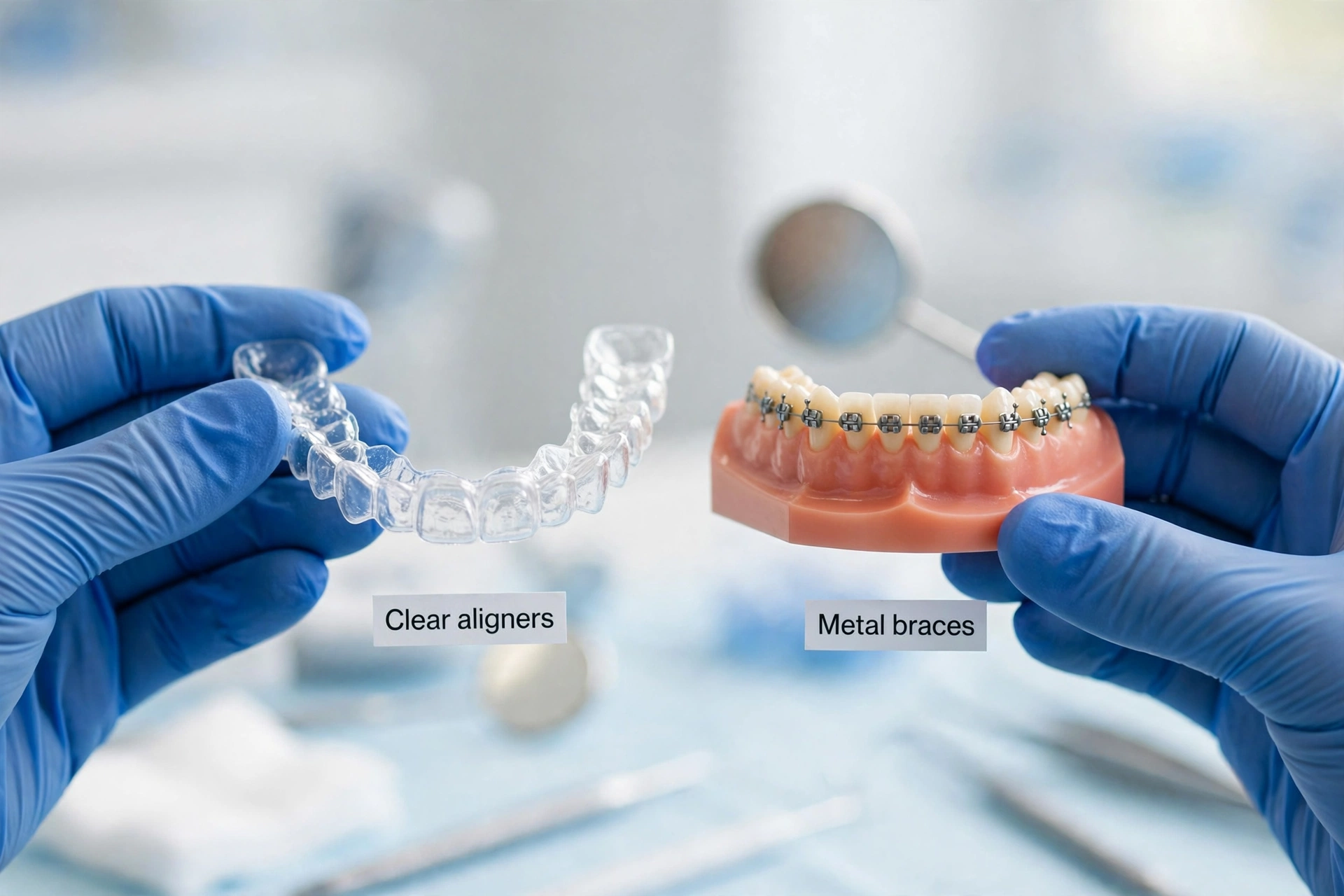
Invisalign is a series of custom-made, removable clear plastic trays. You wear each set for one to two weeks, then move to the next. You take them out to eat, brush, and floss.
Braces are fixed metal or ceramic brackets bonded to your teeth, connected by a wire that your orthodontist adjusts every four to six weeks. The force is constant. You cannot take them off, forget them, or lose them.
That one difference — removable versus fixed — drives almost every other difference in this guide: cost, comfort, cleaning, appointments, and whether the treatment succeeds.
How much do Invisalign and braces cost for adults in 2026?
Use the table below as a planning guide. Prices vary by case complexity, city, and provider experience. A mild case that needs only a few teeth moved costs far less than a full bite correction.
| Treatment | Typical range without insurance (2026 guides) | Notes |
|---|---|---|
| Metal braces (full treatment) | $3,000–$7,000 | The standard option; most predictable for complex cases |
| Ceramic braces | $4,000–$8,000 | Tooth-coloured brackets; usually $500–$1,500 more than metal |
| Lingual braces (behind the teeth) | $8,000–$13,000 | Hidden, but the most expensive and hardest to clean |
| Invisalign (full treatment) | $3,500–$8,000 | Mild cases can be less; complex cases sit at the top of the range |
| Retainers after treatment | Ask for the price in writing | Not verified as a published range on 7 Nov 2026 — do not assume they are included |
Sources for these ranges: 2026 consumer and clinic guides seen 7 Nov 2026 (The Healthy Attitude; MySpecialtyDentist; Smile To Love, updated 1 Oct 2026; 85ideas, published 8 Oct 2026; Friendly Dental of Somerset; Guidry & Horaist Orthodontics). Secondary sources; planning ranges only.
Why two adults can get very different quotes
- Case complexity. Mild crowding is a short, cheap case. A deep bite, severe rotations, or a jaw-position problem is a long, expensive one — and may rule out aligners entirely.
- Location and provider. Fees in large coastal cities are usually higher than in smaller towns, and an orthodontic specialist may charge more than a general dentist offering aligners.
- What is included. Ask whether the quoted price covers records and scans, all aligner sets or adjustments, emergency visits, and retainers. If retainers are not included, that is an extra cost after treatment ends.
Ask every office for the same thing: an itemised written estimate that lists what is included and what is not. If two quotes look very different, check whether they include the same parts before you compare them.
The hidden costs nobody puts in the headline price
The headline price is rarely the total price. Before you sign, ask about each of these:
- Replacement aligners. Lose a tray while travelling and a replacement typically costs $100 to $200 per tray, and can delay your timeline while you wait for it.
- Broken brackets and wires. Braces can break. Emergency repair visits cost time and sometimes money, depending on your treatment agreement.
- Extra appointments. Braces need adjustments every four to six weeks, usually 30 to 45 minutes each. Aligner check-ins are every six to eight weeks and often only 15 to 20 minutes. For a working adult, that time away from work is a real cost.
- Extended treatment. If aligner wear slips below 20 to 22 hours a day, teeth drift back and treatment stretches out. Some practices charge for extra aligner sets; ask before you start.
- Retainers, forever. After either treatment, you will need a retainer to stop your teeth moving back. Get the retainer type, its cost, and the replacement cost in writing before treatment starts. Our guide on 10 Important Steps to Look after Your Enamel After Orthodontic Remedy explains why wearing it as directed matters.
Does dental insurance cover Invisalign or braces for adults?
The lifetime maximum is the number that matters
Most US dental plans that cover orthodontics at all pay a lifetime orthodontic maximum — a single total amount for your whole life, not per year. Across 2026 guides seen 7 Nov 2026, that maximum is typically $1,000 to $3,000, often around $1,500 to $2,000. A $6,000 treatment with a $1,500 lifetime maximum still leaves you paying about $4,500 out of pocket, before any deductible or co-pay.
What to check in your own plan, in writing
- Does your plan cover adult orthodontics at all? Many plans cover orthodontics only for children under 19. If yours does not, the full cost is yours.
- What is the lifetime maximum? Get the exact figure, not a guess.
- Is Invisalign covered the same as braces? Most plans cover both to the same extent, but confirm it — do not assume.
- Is there a waiting period or pre-authorisation requirement? Some plans make you wait months, or require approval before treatment starts.
- Does the benefit apply to your provider? In-network and out-of-network benefits can differ sharply.
Call the number on your plan card and write down the name of the person you spoke to, the date, and what they said. A verbal promise is not coverage. Your plan’s benefit booklet is.
Medicare does not help here
Original Medicare does not cover routine dental care, including orthodontics, in most cases. Some Medicare Advantage plans include a limited dental benefit, but orthodontics for adults is rarely covered. If you are over 65, read our guide on Dental Implants for Seniors Over 65 in the USA in 2026: Medicare, Costs, and Safer Alternatives first — it explains what Medicare does and does not pay for.
Ways to lower the cost
- Use an FSA or HSA. Orthodontic treatment is usually an eligible expense, and paying with pre-tax money can save you a meaningful amount.
- Ask about monthly payment plans. Most practices offer financing over 24 to 36 months. Ask for the total cost including any interest, not just the monthly figure.
- Ask about dental schools. University orthodontic clinics, supervised by experienced faculty, often charge less than private practices, though treatment takes longer.
- Get two written estimates. Compare the same parts — records, treatment, retainers, emergency visits — not just the headline number.
What actually changes after 40
The AAO’s guidance for adults is straightforward: the biology of moving teeth is the same at any age, but adults bring a very different context to the chair. Here is what that means in practice.
Gum disease comes first
The CDC reports that about 47.2% of US adults aged 30 and older have some form of periodontal disease, rising to about 70% at age 65 and older. Moving teeth in an unhealthy mouth can make gum disease worse and loosen teeth. Your orthodontist will want your gums healthy and stable before treatment starts, and may want more frequent cleanings during treatment. For more on why early gum treatment matters, see our guide on How Can Early Remedy of Gum Illness Save Your Smile.
Bone is denser, so movement is slower
Adult bone has finished growing. The AAO notes that adult treatment may take slightly longer than the same case in a teenager, because mature bone remodels more slowly. That is one reason adult treatment often runs 12 to 24 months even for moderate cases.
You probably have restorations — and they matter
Crowns, bridges, implants, and large fillings change what is possible. A tooth with a crown can still be moved, but the bracket may not bond the same way. An implant cannot be moved at all, so teeth around it must be moved instead. Tell your orthodontist about every restoration at the first visit.
Relapse is common — and it is not your fault
Many adults over 40 had braces as teenagers and stopped wearing their retainer years ago. Teeth shift throughout life, and bone density decreases with age, which gives teeth more room to move. This is the most common reason adults return for treatment. The fix is the same either way: straighten the teeth, then wear a retainer as directed — this time for life, at night.
Grinding, medicines, and health conditions
If you clench or grind your teeth at night, tell your orthodontist. Grinding can damage aligners, break brackets, and put extra force on teeth that are already moving. A night guard may be part of the plan. For background, see our guide on 12 Methods Tooth Grinding Can Destroy Your Oral Well Being. Some medicines — including smoking, clenching, and certain bone medicines — can also affect how teeth move and heal, so bring a full medicine list to your consultation and tell your orthodontist about diabetes, osteoporosis, or any condition your doctor is monitoring.
Invisalign vs braces: side by side for adults over 40
| Factor | Invisalign | Metal braces |
|---|---|---|
| Typical cost (2026, USA) | $3,500–$8,000 | $3,000–$7,000 |
| Typical treatment time | 6–18 months (mild to moderate) | 18–24 months (comprehensive); longer for complex cases |
| Appointments | Every 6–8 weeks, often 15–20 minutes | Every 4–6 weeks, usually 30–45 minutes |
| Appearance | Nearly invisible | Visible; ceramic brackets are less obvious |
| Eating | Remove trays; no food limits | No popcorn, hard nuts, sticky sweets, or chewy candy |
| Cleaning | Brush and floss normally | More time cleaning around brackets and wires |
| Comfort | Smooth trays; mild pressure with each new set | Brackets can irritate cheeks; soreness after adjustments |
| Compliance | Must wear 20–22 hours a day | Works automatically — nothing to remember |
| Best for | Mild to moderate crowding, spacing, overbite, underbite | Severe crowding, major rotations, complex bite correction |
| Risk if you slip | Teeth drift back; treatment extends | Broken bracket or bent wire; extra visit |
Which one should you choose?
There is no single right answer. Use this framework instead:
Choose Invisalign if your case is mild to moderate, you want the most discreet option, and you can honestly commit to 20 to 22 hours of wear every day.
Choose braces if your case is complex, your orthodontist flags severe rotations or a significant bite problem, or you know you will not wear aligners reliably.
Choose ceramic braces if you want the reliability of fixed braces with a less visible look, and you accept the higher price.
Get a second opinion if one practice recommends a treatment that feels wrong, quotes a price far above the ranges in this guide without explaining why, or pressures you to decide on the same day. A good orthodontist will show you a 3D scan of your teeth, explain what each system can and cannot do for your case, and give you the estimate in writing to take home.
What to ask at your orthodontic consultation
Take this list with you:
- Is my case mild, moderate, or complex — and which system do you recommend for it, and why?
- Are my gums and bone healthy enough to start, or do I need gum treatment first?
- What is the full itemised cost, including records, treatment, emergency visits, and retainers?
- How long will treatment take, and what happens if it takes longer?
- What does my insurance actually cover — and have you checked it, or should I?
- What are my payment options, and what is the total cost including interest?
- What happens if I lose an aligner or break a bracket?
- What kind of retainer will I need, what does it cost, and how long do I wear it?
A good orthodontist will welcome these questions. If you feel rushed, get a second opinion.
Frequently asked questions
Am I too old for Invisalign or braces at 40, 50, or 60?
No. The American Association of Orthodontists states that you are never too old for orthodontic treatment, and that it can be as successful for adults as for adolescents. Age is rarely the deciding factor. Gum health, bone, and your dental history matter far more.
How much does Invisalign cost for adults in the USA in 2026?
Invisalign typically costs $3,500 to $8,000 for adults in the USA in 2026, according to multiple 2026 guides. Mild cases can cost less. The final price depends on case complexity, treatment length, location, and provider.
Are braces cheaper than Invisalign for adults?
Usually only slightly. Metal braces typically cost $3,000 to $7,000, while Invisalign typically costs $3,500 to $8,000. The ranges overlap so much that your case matters more than the system. Ceramic braces ($4,000–$8,000) cost about the same as Invisalign.
Does insurance cover Invisalign for adults?
Sometimes, but rarely in full. Many dental plans that cover adult orthodontics pay a lifetime maximum of about $1,000 to $3,000, and some plans cover no adult orthodontics at all. Most plans cover Invisalign to the same extent as braces, but check your own plan in writing.
How long does Invisalign take for adults over 40?
Mild to moderate cases often take 6 to 18 months. Comprehensive adult treatment with either system often takes 12 to 24 months, and complex cases can take longer, because adult bone remodels more slowly than a teenager’s.
Can I get Invisalign if I have gum disease?
Not until the gum disease is treated and stable. Moving teeth in an unhealthy mouth can make gum disease worse. Your orthodontist will usually want your general dentist or periodontist to treat the gum disease first.
Do I have to wear a retainer forever?
In practice, yes — usually at night, for life. Teeth shift throughout life, and without a retainer they will gradually move back toward their original positions. This is true after both Invisalign and braces.
The bottom line
- Invisalign and braces cost about the same for most adults over 40 in 2026: roughly $3,000 to $8,000.
- Invisalign is faster for mild to moderate cases, but only if you wear the trays 20 to 22 hours a day.
- Braces are the safer choice for complex cases and for anyone who will not wear aligners reliably.
- Insurance usually pays only $1,000 to $3,000 over your lifetime, if it covers adult orthodontics at all.
- Gum disease, bone, crowns, and implants matter more than your age. Get those checked before you choose.
- Get a written, itemised estimate, ask about retainers before you start, and get a second opinion if you feel pressured.
Straightening your teeth after 40 is not vanity. Crowded teeth are harder to clean, and harder-to-clean teeth are more likely to develop cavities and gum disease. The right system is the one you will actually finish — and the right price is the one you see in writing before treatment starts.