



At-Home Clear Aligners vs Dentist-Supervised Aligners: Safety, Cost, and the ADA Warning
The quick answer
At-home aligners are cheaper, and that is the whole appeal. A mail-order set costs roughly $649-$1,499 in 2026, while dentist-supervised treatment usually costs $3,000-$7,000. But the price gap is not a bargain found. It is the exam, the X-rays and the monitoring taken out, and the risk that goes with them handed to you.
The FDA warned consumers on 1 October 2026 about unauthorized direct-to-consumer clear aligners sold without supervision by a dentist or orthodontist. Clear aligners are prescription devices. The FDA said it has not authorized clear aligners marketed directly to consumers without supervision, and that a lack of supervision may increase the risk of complications. That does not mean every mail-order tray harms every wearer. It means the unsupervised model has no FDA authorization behind it, and the safety net that catches problems early is missing.
If your teeth need only a small correction, your gums and bone are healthy, and you understand what you are giving up, mail-order aligners may still be an option you weigh. If you have gum disease, bone loss, a bite problem, jaw pain, or a complex case, supervised care is the safer choice, and for some people it is the only sensible one. This guide compares the two paths on safety, cost and what actually happens when something goes wrong, so you can decide with the facts in front of you.
What at-home aligners are, and what dentist-supervised means
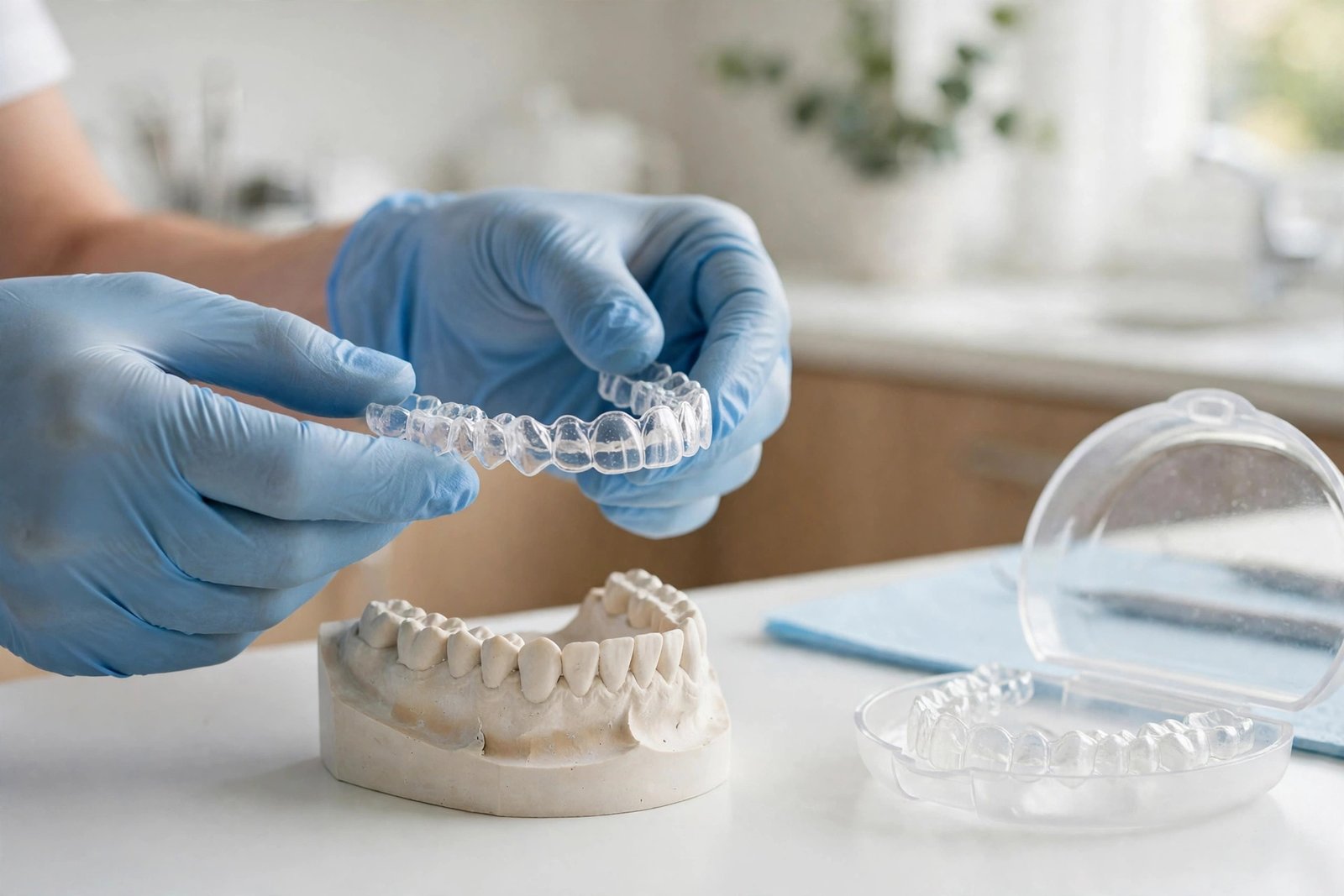
At-home aligners, also called mail-order or direct-to-consumer aligners, arrive by post. You take your own dental impressions at home with a kit, or you visit a scan shop for a 3D scan, and a company sends you a series of clear plastic trays. You change the trays yourself, usually every one to two weeks, and you track your own progress, sometimes with a phone app and sometimes with no check-in at all. No dentist or orthodontist examines your mouth in person before treatment starts, and no one takes X-rays.
Dentist-supervised aligners start the other way round. A dentist or orthodontist examines your teeth and gums in person, takes X-rays, checks your bite and your jaw joint, and decides whether aligners can move your teeth safely at all. Only then is a treatment plan made. During treatment you return for check-ups, usually every 6-10 weeks, so the dentist can see whether the teeth are moving as planned, whether the bite is staying even, and whether the gums are coping. The trays look similar. The care around them does not.
The difference matters because moving teeth is not cosmetic in the way whitening is. Teeth sit in living bone, held by ligaments and fed by blood vessels. Move them too fast, in the wrong direction, or against an unhealthy foundation, and the damage can be permanent: a tooth can loosen, a root can shorten, the bite can open, and the jaw joint can start to hurt. A dentist checks the foundation before anything moves. A mail-order kit cannot.
The FDA warning of 1 October 2026
On 1 October 2026 the FDA warned consumers about unauthorized direct-to-consumer clear aligners sold without supervision by a dentist or orthodontist, and ADA News reported the warning the same month. The warning is short and plain. Clear aligners are prescription devices. The FDA has not authorized clear aligners marketed directly to consumers without supervision. A lack of supervision may increase the risk of complications.
The problems the FDA said it had received reports about are specific, and worth reading as they are: new or worsening dental pain, jaw pain, bite problems, worsening misalignment, and new gaps between teeth. These are not theoretical risks from a textbook. They are reports from real patients, and they are the kind of problems that an in-person exam and monitoring are designed to catch early, when they are still fixable.
The warning also draws a line that marketing often blurs. FDA-registered is not FDA-authorized. Registration means a manufacturer listed its facility and its products with the FDA. Authorization means the FDA reviewed the specific product and cleared or approved it. A company can be registered and still be selling a product the FDA has not authorized for unsupervised use. Patients can check the FDA 510(k) database using product code NXC if they want to see what has actually been cleared, and what has not.
An in-person exam can reduce the risk of an uneven bite, unintended tooth movement, pain and tooth loss, because it catches the things a home impression cannot: gum disease under the gumline, a root problem, bone loss, and a bite that is already off. Remote monitoring and virtual visits can be part of care, but periodic in-person visits still matter, because some things need hands and eyes in the room, not a photo on a phone.
What the ADA and AAO say
The American Dental Association opposes direct-to-consumer dentistry that skips a proper exam and records. The risks it names are bone loss, receding gums, bite problems and jaw pain, the same problems the FDA reports describe. The ADA’s teledentistry policy allows treatment at a distance only if the dentist gathers the same information an in-person exam would and takes responsibility for the patient. A kit that never puts a dentist in charge of your case does not meet that standard.
The American Association of Orthodontists says the same about mail-order treatment that leaves out an in-person evaluation and X-rays. Orthodontists are the specialists who move teeth for a living, and their position is that a scan or an impression alone is not a substitute for an examination.
A pretreatment exam and X-rays catch gum disease and root problems that make tooth movement riskier. Gum disease loosens the foundation a tooth moves through. Bone loss does the same. If either is present and untreated, moving the tooth can make it worse, and it can do so quietly, without pain, until the tooth is already loose. That is why the exam comes first in supervised care, and why skipping it is the central risk of the mail-order model. If you already know you have bone loss, read our guide to what that means for implants, because the same foundation problem shapes aligner treatment too: Dental Implants After Bone Loss: Bone Graft, Sinus Lift, and When Implants Are Not Possible
What it all costs, on one page
| Treatment | Typical US range, 2026 | What is included |
|---|---|---|
| At-home / mail-order aligners | $649-$1,499 advertised | Trays, impression kit or scan, remote plan, retainers sometimes included |
| AlignerCo, mail-order | From $725 | Trays and remote plan, as advertised in Sep-Oct 2026 guides |
| SmileSet, mail-order | From $1,395 | Trays and remote plan, as advertised in Sep-Oct 2026 guides |
| Dentist-supervised Invisalign | $3,000-$7,000 | Exam, X-rays, plan, trays, check-ups, refinements, retainers often included |
| Dentist-supervised ClearCorrect | $2,500-$6,000 | Exam, X-rays, plan, trays, check-ups, refinements |
| Dentist-supervised Spark | $3,000-$8,500 | Exam, X-rays, plan, trays, check-ups, refinements |
| Retainers after treatment | $100-$300 per set | Replaced every 6-12 months, both paths |
All figures are typical US ranges from Sep-Oct 2026 guides, not quotes, and guides disagree, which is why this guide uses ranges. Prices vary by provider, region, case complexity and insurance.
The gap exists for a reason. Mail-order cuts out the in-person exam, the X-rays and the monitoring. That is where the saving comes from. It is not a discount on the same product. It is a different product, with the safety checks removed, and the risk that those checks would have caught now sits with you. A cheap plan that moves a tooth the wrong way and needs fixing can cost more than the supervised plan would have cost in the first place.
Two more costs hide in the small print. First, refinements. Supervised plans usually include extra trays if the teeth do not track the plan. Mail-order plans may charge for them, or may not offer them at all. Second, retainers. Teeth move back without them, and a retainer set costs $100-$300 and needs replacing every 6-12 months, whichever path you took. Ask before you pay whether retainers and refinements are included, and get the answer in writing.
Insurance changes the maths on the supervised side only. Some dental plans cover part of orthodontic treatment, usually up to a lifetime orthodontic maximum, and many exclude adult treatment or mail-order aligners entirely. If you have insurance, ask for the orthodontic benefit, the lifetime maximum and whether at-home aligners are covered at all, before you compare prices. Our guide to reading the fine print explains how to check: Dental Insurance With No Waiting Period for Implants in the USA: How to Read the Fine Print
For adults over 40 weighing Invisalign against braces, the supervised cost and the over-40 angle are covered in detail here: Invisalign vs Braces for Adults Over 40 in the USA in 2026
How long each path takes
A mild case takes about 6-12 months on either path, and the calendar looks similar on paper. The difference is what happens inside those months.
In supervised care, the first appointment is the exam and the X-rays, then the plan, then the trays, then a check-up every 6-10 weeks. If a tooth is not tracking, the dentist sees it at the next visit and orders a refinement, a new set of trays that corrects the course. Refinements add weeks, but they are part of the plan, and most supervised plans include them.
In mail-order care, the first step is the impression kit, then the trays arrive by post, and you change them yourself every one to two weeks. If a tray does not fit, or a tooth does not move, there is no visit on the calendar to catch it. Some companies offer a remote check-in through a phone app, but a photo cannot show whether the bite is closing evenly or whether a root is under strain. A patient who notices a problem late can lose months, and the fix often means starting over with a new plan, or with a dentist.
The retainer phase is the same on both paths, and it is the part most people underestimate. Teeth move back without retainers, for life. A retainer set costs $100-$300 and needs replacing every 6-12 months, whichever path you took. Budget for it as part of the treatment, not as an afterthought, or the correction you paid for will slowly undo itself.
What happened to SmileDirectClub and Byte
The history of the at-home industry is the strongest argument for caution, and it is not ancient history. SmileDirectClub was the biggest mail-order aligner company in the USA. It filed for Chapter 11 bankruptcy on 29 September 2023 and shut down all operations on 8 December 2023, leaving customers mid-treatment with no replacement trays, no retainers and no clinical support. The case was converted to Chapter 7 in January 2024. The New York Attorney General later recovered $4.8 million for more than 28,000 consumers who had been charged after the shutdown, announced on 2 December 2024. Thousands of people were left with half-moved teeth and no one to finish the job.
Byte was the other big name. Dentsply Sirona suspended sales and marketing of Byte on 24 October 2024, and confirmed on 14 January 2025 that it is not reinstating at-home Byte Aligner Systems and Impression Kits. There is no Byte plan fee to quote in 2026. Some comparison tables still list one. Those tables are pricing a product that cannot be bought, and any guide that quotes a Byte price as live is out of date.
Candid closed its direct-to-consumer business and its studios in January 2022 and moved to a model run through dental offices, under the name CandidPro. Brands still operating on the mail-order model in 2026, according to Sep-Oct 2026 guides, include AlignerCo from $725 and SmileSet from $1,395. SmileSet acquired SmileDirectClub technology and patents after the bankruptcy. No published study ranks at-home brands by safety, so do not let any brand call itself the safest. There is no evidence for that claim.
The lesson is not that every mail-order company will fail. It is that a treatment that takes 6-12 months needs a company that will still be there in 6-12 months, and a patient who is mid-treatment when a company closes has no dentist of record to turn to. Supervised care has a dentist of record from day one. That is part of what the higher price buys.
The risks without supervision
The risks are not one risk. They are a chain, and each link is something an exam or a check-up would have caught.
The first is an undiagnosed problem. Gum disease, bone loss, a dead tooth, a cracked root or a cavity under an old filling can all be invisible to the patient and obvious on an X-ray. Move a tooth with gum disease and the disease can accelerate. Move a tooth with a cracked root and the root can fail. A home impression sees none of this.
The second is a wrong plan. A scan or an impression shows the crowns of the teeth, the parts above the gum. It does not show the roots, the bone or the bite in function. A plan made from crowns alone can move a tooth into a position the root cannot support, or into a bite that does not close evenly. The result is the FDA list: new pain, jaw pain, bite problems, worsening misalignment, new gaps.
The third is no one watching. Teeth do not always follow the plan. A tray that does not fit, a tooth that does not move, or a bite that opens mid-treatment are all fixable if they are seen early. Without check-ups, they are seen late, when the fix is bigger, slower and more expensive. In supervised care, a dentist who sees a tooth not tracking can order a refinement, change the plan, or stop and reassess. In mail-order care, the patient is the one who has to notice, and most patients do not know what to look for.
The fourth is the end of treatment. Teeth move back without retainers, and retainers need fitting and replacing. A patient who finishes mail-order treatment without a proper retainer plan can watch the correction undo itself over months, and pay again to redo it.
None of this means supervised care is risk-free. It is not. Teeth can fail to track, roots can shorten, and gums can recede under supervised care too. The difference is that supervised care has a clinician watching for those things, a plan for when they happen, and a dentist of record to fix them. Mail-order care leaves the watching to the patient.
Who at-home may suit, who should avoid it, and the checklist
At-home aligners may suit a narrow group: an adult with healthy gums and bone, no bite problem, no jaw pain, no missing teeth or implants in the way, and a mild correction, a small gap or slight crowding, who understands the FDA warning and accepts the risk. Even then, a pretreatment exam with a dentist of your own, before you order, is the single best safety step you can take. It costs a fraction of the treatment and it catches the problems that make mail-order unsafe.
At-home aligners should be avoided, or at least not started without a dentist’s say-so, by anyone with gum disease, bone loss, receding gums, bite problems, jaw pain, complex movement, missing teeth or implants in the way, or by children and teens, whose jaws are still growing and whose teeth should not be moved without a specialist watching.
Take this checklist to any decision, mail-order or supervised. Ask all seven before you pay anything.
- Has a dentist or orthodontist examined my mouth in person and taken X-rays, and what did they find?
- Are my gums and bone healthy enough for tooth movement, and is there any disease to treat first?
- Is my case mild enough for aligners at all, or does it need attachments, IPR, elastics or braces?
- Who is the dentist of record for my case, and how do I reach them if something hurts or the bite changes?
- How often will someone check my progress, and what happens if a tooth does not track the plan?
- Are refinements and retainers included, and what do they cost if they are not?
- If the company closes or stops answering, who finishes my treatment?
If a company cannot answer the fourth question with a named dentist, that is your answer. Do not pay.
For older patients, the same foundation question meets a different calculation, whether any orthodontic spend is the right one at all, and our seniors guide works through the wider picture: Dental Implants for Seniors Over 65 in the USA in 2026: Medicare, Costs, and Safer Alternatives
What to do if you are already wearing mail-order aligners
If you are already in mail-order treatment, do not panic, and do not stop mid-tray without advice. Stopping can leave teeth half-moved, which is worse than either finishing or being properly reassessed. Instead, do these things in order.
First, see a dentist or orthodontist in person, soon, and tell them exactly which company, which tray number, and how long you have been wearing them. Bring the trays and the plan if you have it. Ask for an exam and X-rays, and ask specifically whether your gums, bone and bite are coping.
Second, stop and get help urgently if you have new or worsening dental pain that does not settle, jaw pain, a bite that has changed suddenly, a tooth that feels loose, or a gap that has opened where there was none. These are the problems the FDA reports describe, and they are the ones that get worse if you keep wearing the next tray.
Third, keep every record: the order confirmation, the plan, the tray numbers, the dates you changed trays, and any messages with the company. If the company closes, or if you need a refund or a complaint, those records are your evidence.
Fourth, if the company has closed or stopped responding, a local orthodontist can take over, but expect a new exam, new X-rays and a new plan, and expect to pay for them. That is the cost of a treatment with no dentist of record, and it is worth budgeting for before you order, not after.
Frequently asked questions
Are at-home aligners safe?
They can be, for a narrow group: healthy gums and bone, no bite problem, no jaw pain, and a mild correction. The FDA has not authorized the unsupervised model, and the risks are an undiagnosed problem, a wrong plan, and no one watching while the teeth move. A pretreatment exam with a dentist of your own is the single best safety step before you order.
Are at-home aligners FDA approved?
No, not the unsupervised model. Clear aligners are prescription devices. The FDA warned on 1 October 2026 that it has not authorized clear aligners marketed directly to consumers without supervision by a dentist or orthodontist. FDA-registered is not the same as FDA-authorized. Registration means the manufacturer listed its products. Authorization means the FDA reviewed the specific product and cleared or approved it.
What happened to SmileDirectClub?
SmileDirectClub filed for Chapter 11 bankruptcy on 29 September 2023 and shut down all operations on 8 December 2023, leaving customers mid-treatment with no replacement trays, retainers or clinical support. The New York Attorney General recovered $4.8 million for more than 28,000 consumers charged after the shutdown.
Can Byte aligners still be bought?
No. Dentsply Sirona suspended Byte sales and marketing on 24 October 2024 and confirmed on 14 January 2025 that it is not reinstating at-home Byte Aligner Systems and Impression Kits. Any guide still quoting a Byte price in 2026 is out of date.
How much do at-home aligners cost in 2026?
Mail-order aligners are advertised at about $649-$1,499 in 2026, with AlignerCo from $725 and SmileSet from $1,395 in Sep-Oct 2026 guides. Dentist-supervised Invisalign typically costs $3,000-$7,000 and ClearCorrect $2,500-$6,000. Retainers cost $100-$300 per set and need replacing every 6-12 months. These are ranges from guides, not quotes.
Do I need X-rays before aligners?
Yes, according to the ADA and the AAO. An in-person exam and X-rays catch gum disease, bone loss and root problems that make tooth movement riskier, and they show whether your case is mild enough for aligners at all. A scan or an impression alone does not show the roots, the bone or the bite in function.
This article is general information, not a diagnosis and not a substitute for advice from your own dentist or orthodontist. Aligners move teeth in living bone, and whether they are safe for you depends on your gums, your bone, your bite and your X-rays. Take the checklist above to a consultation and get a written plan, with prices, before you decide.