

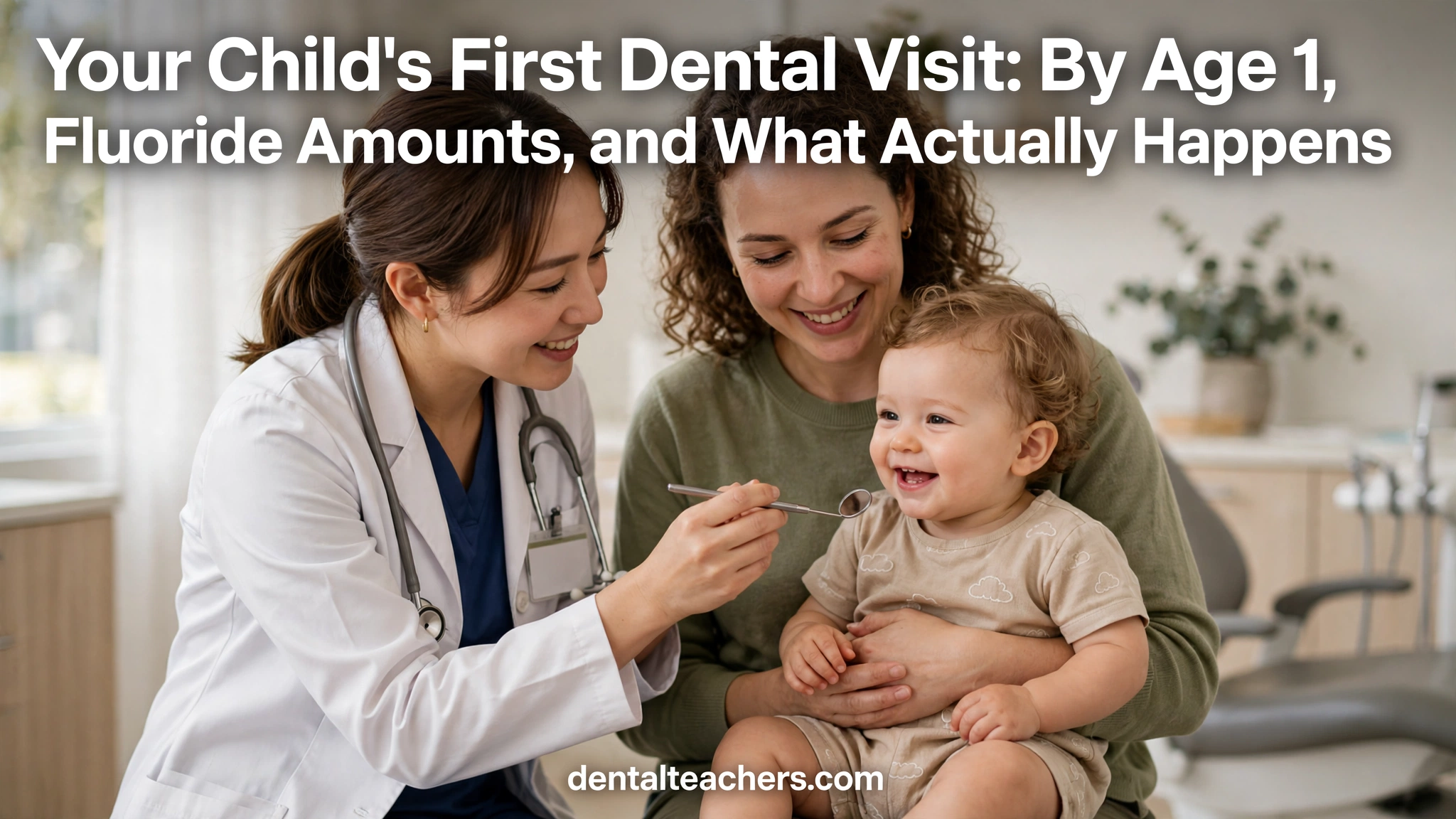

Most parents are surprised by the timing. The first dental visit is not at age 3, when a child can sit still and answer questions. It is by age 1, often when the child has only one or two teeth, and sometimes when the child has none at all that a parent can see clearly.
That timing is not a marketing idea. It is the shared advice of the American Academy of Pediatric Dentistry, the American Dental Association, and the American Academy of Pediatrics. Book the first visit when the first tooth appears, and no later than the first birthday. The AAPD puts the same rule a second way: within 6 months of the first tooth erupting.
This guide explains that visit in plain language, for a parent in the USA. It explains why age 1 matters, when to book, what actually happens in the room, how much fluoride toothpaste to use at each age, what the dentist will ask you, and how to prepare a one year old for a visit with a stranger who wants to look inside their mouth.
This guide is general education, not medical advice. If your child has a specific tooth, feeding, or health concern, discuss it with your child’s dentist or pediatrician. Nothing here replaces that conversation.
The short answer
Book the first dental visit when the first tooth comes in, and no later than your child’s first birthday. If the first tooth arrives at 6 months, book then. If it arrives later, do not wait past the first birthday to make the appointment.
The visit is short, gentle, and mostly about you, the parent. The dentist counts the teeth that have erupted, checks the gums and how the jaw is developing, and spends most of the time talking with you about brushing, feeding, bottles, and habits. The exam itself is often about 10 to 20 minutes, and the whole appointment usually runs 20 to 30 minutes, though that varies by practice.
Start brushing as soon as the first tooth appears, twice a day, with fluoride toothpaste. From the first tooth until age 3, use a smear the size of a grain of rice. From age 3 to 6, use a pea-sized amount, no more. After the first visit, the usual rhythm is a checkup every 6 months, adjusted by your dentist if your child is at higher risk.
If your child is already past the first birthday and has not been yet, book now. A first visit at age 2 or 3 does the same job: it checks for early decay, gives you a home care plan, and lets your child get used to the dentist. It is late, but it is not too late.
Why age 1 matters more than it sounds
Baby teeth are small, and they fall out, so it is easy to think they do not matter much. They do. Baby teeth hold space for the permanent teeth, they help a child chew and speak clearly, and decay in a baby tooth can cause pain and infection that affect eating, speaking, playing, and learning.
Decay can start soon after the first teeth appear. The CDC reports that more than half of children aged 6 to 8 have had a cavity in at least one baby tooth. That figure surprises most parents, because the damage often starts quietly, before a child can say that a tooth hurts.
An early visit catches that quiet start. The dentist looks for the first white spots and early signs of decay, checks how the teeth are coming in, and talks through the habits that cause most early cavities: bottles at bedtime, juice and sweet drinks through the day, and brushing that misses the back teeth.
There is a second reason, and it is about familiarity. A child who meets the dentist at age 1, in a calm visit with no drilling and no needles, learns that the dental office is an ordinary place. A child whose first visit happens at age 3, because a tooth already hurts, meets the dentist as the person who has to fix a problem. The first path is easier for the child, for the parent, and for the dentist.
A third reason is that the visit is really a coaching session for the family. Most of what protects a baby’s teeth happens at home, twice a day, with a small brush and a tiny amount of toothpaste. The first visit is where a parent learns exactly how much toothpaste, how to hold a wriggling child still enough to brush, and which feeding habits to change first.
When to book, and what to do if you are late
The rule is simple, and it has two parts. Book when the first tooth appears, and do not let the first birthday pass without a visit. Whichever comes first is the trigger.
Most babies get their first tooth at around 6 months, usually a lower front tooth. For most families, that puts the first visit between 6 and 12 months. Some babies get a tooth earlier, some later. A late first tooth is usually normal, and it does not change the rule: book by the first birthday either way.
If your child is 18 months old and has not been, book this week. If your child is 2 or 3 and has not been, book now and do not wait for a problem to force the visit. The dentist will do the same first visit, a gentle exam, a check for early decay, fluoride varnish if it is indicated, and a home care plan, and will set the next visit, usually 6 months later.
One practical point: book the visit for a time when your child is usually at their best, often in the morning after a nap and a snack, not at the end of a long day. A tired one year old cries more easily, and a crying child is harder to examine, even though crying itself is normal and does not mean anything went wrong.
Baby teeth, in order
A child usually has 20 baby teeth, and most children have all 20 by about age 3. The order is fairly predictable, though the timing varies from child to child.
| Age, roughly | What usually happens |
|---|---|
| Around 6 months | First tooth, usually a lower front tooth |
| 6 to 12 months | More front teeth, top and bottom |
| 12 to 18 months | First molars and canine teeth begin to appear |
| Around age 2 | Second molars begin to appear |
| By about age 3 | All 20 baby teeth are usually in place |
These ages are general guides, not deadlines. A child who gets a first tooth at 4 months and a child who gets one at 12 months can both be perfectly normal. What matters is the visit by age 1, and the brushing that starts with the first tooth, whenever it arrives.
Once two teeth touch each other, they need flossing as well as brushing, because a brush cannot clean between teeth that touch. Your dentist will show you how to do this for a small child, and will tell you when to start for your child’s teeth.
How much fluoride toothpaste, by age
This is the part parents get wrong most often, and it is almost always in the same direction: too much. A full brush of toothpaste looks right, because that is what adults use. For a small child, it is far too much.
The amounts below are the shared advice of the ADA, the AAPD, and the AAP. Use fluoride toothpaste from the first tooth, twice a day, in these amounts.
| Age | Amount of fluoride toothpaste | Who brushes |
|---|---|---|
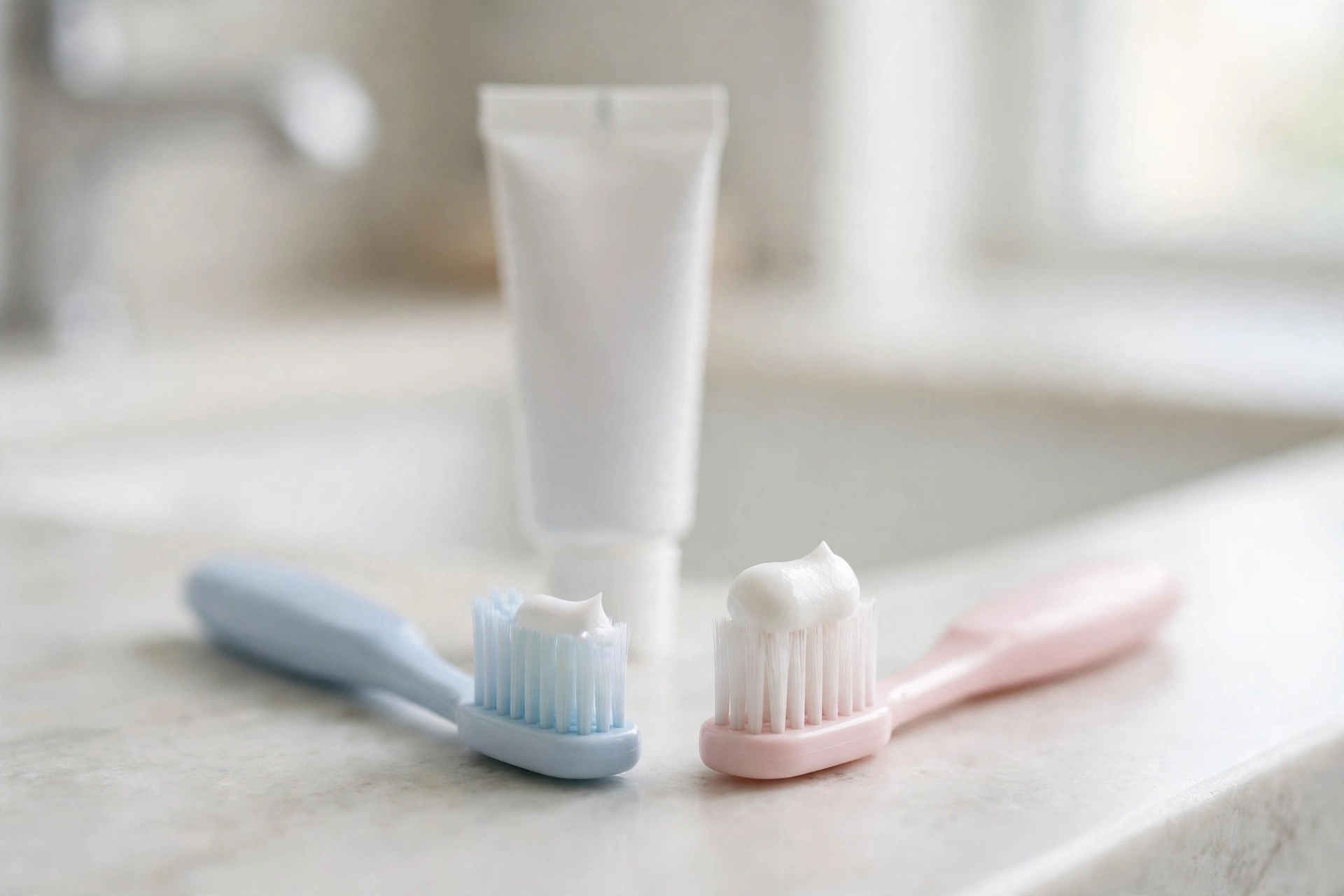
| First tooth to age 3 | A smear the size of a grain of rice | A parent or carer brushes the child’s teeth |
| Age 3 to 6 | A pea-sized amount, no more | The child brushes, with an adult helping and checking |
| Age 6 and over | A pea-sized amount | The child brushes, with an adult checking until the child can spit reliably and brush well alone |
A rice-grain smear holds about 0.1 mg of fluoride, and a pea-sized amount holds about 0.25 mg. Those small amounts are deliberate. A young child swallows most of what goes on the brush, so the amount on the brush is the amount the child takes in. The main risk of using too much, over time, is mild white marks on the adult teeth, a condition called fluorosis. The small amounts keep that risk low while still protecting against cavities.
Two practical points belong here. First, a parent should do the brushing until about age 3, and should help and check until the child can brush well alone, which is often around age 6 or 7. A child who brushes alone too early usually misses the back teeth. Second, teach the child to spit out the toothpaste, not to swallow it, and do not rinse with a large glass of water straight after brushing, because rinsing washes the fluoride away from the teeth.
One caution about labels: USA toothpaste labels say children under 2 should consult a dentist or doctor. That wording sits next to the guideline advice to start fluoride toothpaste at the first tooth, with a rice-grain smear. If the label worries you, ask your own dentist at the first visit. The label is not a ban, and it is not a reason to use fluoride-free toothpaste, which does not protect against cavities in the same way.
Ask your dentist about the fluoride in your household water, too. If your water comes from a municipal supply, it usually contains fluoride. If it comes from a well, it may not. That answer decides whether toothpaste and any fluoride varnish carry the whole prevention load, or whether your dentist suggests anything more.
What happens at the visit
A first visit looks almost nothing like an adult appointment, and that is by design. There is no long cleaning, no drilling, and usually no X-rays. Most of it is a conversation with you.
Here is what usually happens, step by step.
First, the dental team reviews your child’s medical history, feeding patterns, and any family dental concerns. Bring a short list: any medicines, any allergies, how your child is fed, and anything that worries you about the teeth or the mouth.
Second, the dentist examines your child’s mouth. For a very young child, this is usually a knee-to-knee exam. You sit facing the dentist, your child sits on your lap, and your child is laid back so their head rests in the dentist’s lap. Your child can see you the whole time. The dentist counts the teeth that have erupted, checks the gums and the soft tissues of the mouth, looks at how the jaw is developing, and checks the bite, the way the upper and lower teeth meet.
Third, the dentist wipes or gently brushes the teeth, and may apply fluoride varnish if it is indicated. Fluoride varnish is a thin protective coating painted onto the teeth in seconds. It sets on contact with saliva, and it strengthens the enamel against decay. It is quick, and it does not hurt.
Fourth, the dentist shows you how to brush your child’s teeth, and, once teeth touch, how to floss them. This demonstration is a large part of the visit, because home care is where most of the prevention happens.
Fifth, the dentist talks through feeding, bottles, sippy cups, snacks, and habits such as thumb sucking and pacifier use. The questions are practical, not judgemental: what goes in the bottle, what your child sips through the day, and when the bottle will be retired.
X-rays are usually not needed at a first visit unless there is a specific concern, for example a tooth that looks damaged or a bite problem the dentist wants to see more clearly. If an X-ray is needed later, your dentist will explain why.
The whole appointment usually runs 20 to 30 minutes, and the exam itself is often about 10 to 20 minutes. Many children cry anyway, which is normal for a one year old asked to lie back for a stranger. Crying does not mean anything went wrong, and it does not mean the visit failed. The dentist has seen it many times before.
What the dentist will ask you
Most of the first visit is the dentist asking you questions, because the answers shape the home care plan. Expect questions in three areas.
Feeding: what goes in the bottle or cup, and what your child sips through the day. Frequency matters more than amount here. A bottle of milk or juice at bedtime, or juice sipped slowly all day, keeps sugar on the teeth for hours. Water is the safe drink between meals, and milk belongs with meals, not in bed.
Home care: how you brush, how often, and how much toothpaste you use. The dentist will ask who brushes, whether the back teeth get reached, and whether your child spits or swallows. If brushing is a struggle, say so. The dentist can suggest positions and routines that work for a wriggling toddler, and low expectations of cooperation are normal at this age.
Habits and water: pacifier use, thumb sucking, teething, and whether your household water carries fluoride. Pacifiers and thumb sucking are common in the first year, and the dentist will talk about when to start easing them, usually before they affect how the teeth line up. Teething discomfort is also worth mentioning, so the dentist can tell normal teething from a problem that needs a closer look.
Bring your own questions, too. The checklist at the end of this guide lists the ones most parents find useful, including fluoride varnish, the next visit date, and what to do if a tooth is chipped or knocked.
Feeding, bottles, and pacifiers
Three habits cause most early cavities, and all three are fixable at home.
The first is the bottle at bedtime. Milk, formula, and juice left on the teeth overnight feed the bacteria that cause decay, because saliva flow slows during sleep and does not wash the teeth clean. If your child still takes a bottle to bed, ask the dentist about moving to water in the bottle, then to no bottle at all. The same applies to a sippy cup carried around all day with juice or sweetened milk in it. Frequent sipping matters more than one sweet drink at a meal.
The second is juice. Juice is often treated as a healthy drink, but for teeth it behaves like a sweet drink. Water is the best drink between meals. If your child drinks juice, keep it with a meal, in a cup rather than a bottle, and keep the amount small. Your pediatrician can advise on the right amount for your child’s age.
The third is the pacifier and the thumb. Both are normal soothing habits in the first year, and neither needs to be stopped at the first visit. The dentist will talk about when to start easing them, because prolonged sucking can affect how the teeth and the jaw develop. Do not try to stop a pacifier the week before the first visit. A calm child is easier to examine than a child who has just lost their main comfort.
Snacks follow the same rule as drinks: frequency matters more than amount. Sticky snacks that stay on the teeth, eaten often through the day, cause more decay than the same snack eaten once with a meal. Fresh fruit, cheese, and crunchy vegetables are kinder to teeth than sweets and sticky dried fruit, and water after a snack helps.
Teething, and what is normal
Teething usually starts at around 6 months, and it brings drooling, chewing, irritability, and sore gums. Those signs are normal. A mild temperature can happen, but a high fever, diarrhoea, or a rash are not teething, and they need a call to your pediatrician.
Cold helps: a clean, chilled teething ring, a cold washcloth, or a cold spoon. Rubbing the gums gently with a clean finger can help too. Ask your dentist or pediatrician before using any teething gel or medicine, because some products are not recommended for babies.
A tooth that comes in a little crooked, or a gap between the front teeth, is usually normal at this age. The dentist checks how the teeth are coming in at the first visit, and will tell you if anything needs watching. Most early spacing and crowding sorts itself out as the jaw grows, and orthodontic decisions, if any are needed, come years later, not at the first visit.
If your child is nervous, and if you are too
A one year old does not need a long explanation, but a little preparation helps. Talk about the visit in positive, neutral language in the days before it. Say the dentist will count the teeth and look at the smile. Avoid words that suggest pain or fear, and avoid promising that nothing will hurt, because a promise you cannot keep makes the next visit harder.
Role play helps for a toddler: count each other’s teeth, look in a mirror, and let your child hold a toothbrush. Bring a comfort toy or blanket, and a snack for after the visit. Keep the morning calm, and do not schedule the visit at the end of a long day.
If you are nervous yourself, that is normal too, and it is worth saying so. Dental anxiety often runs in families, not because it is inherited, but because a child watches a parent’s face. A calm parent helps a child stay calm. If your own anxiety about dental visits is strong, our guide to sedation options explains what dentists can offer for anxious patients, and the same principle applies at a first visit for a child: the visit is kept short, gentle, and free of surprises. See our post on dental anxiety and sedation options for the adult side of that story: https://dentalteachers.com/dental-anxiety-sedation-options-nitrous-oral-iv/
If your child cries through the whole visit, the visit still counts. The dentist still saw the teeth, still checked the gums, and still gave you the home care plan. The next visit is usually easier, because the office is no longer a new place.
The wider family picture
A child’s first visit is also a good moment to think about the adults in the family. Gum disease runs in families, not only because of shared habits, but because the same inflammation story affects adults too. If a parent has diabetes, the dentist needs to know, because diabetes and gum disease affect each other in both directions, and blood sugar control changes how gums heal. Our guide to diabetes and gum disease explains that two-way link, the A1C numbers, and exactly what to tell your dentist: https://dentalteachers.com/diabetes-gum-disease-two-way-link-a1c/
The same inflammation story connects gum disease with heart disease, and our post on the December 2025 heart update explains what changed and what did not: https://dentalteachers.com/gum-disease-heart-disease-aha-update-december-2025/
Catching decay early is the point of the first visit, and early treatment saves more than a filling. Our post on early remedy of gum illness explains what early treatment can save, and why waiting for pain is a poor strategy: https://dentalteachers.com/how-can-early-remedy-of-gum-illness-save-your-smile/
After the first visit, how often
After the first visit, the usual rhythm is a checkup every 6 months. That interval is the AAPD recommendation for most children, and it pairs naturally with the school calendar. Your dentist may suggest a shorter interval if your child is at higher risk, for example if there are early signs of decay, or if fluoride varnish needs to be repeated more often.
At each checkup, the dentist will count the teeth, check for new decay, apply fluoride varnish if it is indicated, and update the home care plan as your child grows. Sealants come later: they go on the permanent molars once they erupt, usually around age 6 and again around age 12, and they protect the grooved chewing surfaces where cavities tend to start. They are not part of a first visit.
Keep brushing twice a day, with the right amount of toothpaste for your child’s age, and keep the 6 month rhythm even when nothing hurts. Prevention visits are cheap in time and effort compared with problem visits, and they are the reason the first visit happens at age 1.
When to seek care sooner
Most first visits are routine, but some signs are worth a call before the next scheduled visit.
Call your dentist sooner if you see white spots or brown spots on the teeth, if a tooth looks chipped or cracked, if the gums bleed often or swell, if your child complains of tooth pain, or if a tooth is knocked loose or knocked out. A knocked-out baby tooth is not usually put back in, unlike a permanent tooth, but the dentist still needs to see your child promptly to check the damage and the teeth around it.
Call your pediatrician if your child has a high fever, swelling of the face, or trouble eating or drinking that does not settle. Pain, swelling, and fever together need prompt attention, not a wait until the next checkup.
Questions to bring to the first visit
Take this list with you, and tick off the answers before you leave.
- How many teeth should my child have by now, and are they coming in normally?
- How much fluoride toothpaste should I use, and should I ask about fluoride varnish today?
- Does our household water have fluoride, and does that change anything?
- When should the bottle be retired, and what should replace it at bedtime?
- When should we stop the pacifier or thumb sucking, and how do we do it gently?
- How do I brush a child who will not sit still, and how do I reach the back teeth?
- When do two teeth that touch need flossing, and can you show me how?
- When is our next visit, and what should I watch for before then?
- What do I do if a tooth is chipped or knocked, and who do I call out of hours?
- Is there anything in my child’s medical history or medicines that changes the dental plan?
Write the answers down at the visit. A short note on your phone is enough, and it saves a second call later.
Frequently asked questions
My baby has no teeth yet. Should we still go by age 1?
Yes. Book by the first birthday even if no tooth has appeared yet. The dentist checks the gums and the mouth, talks through feeding and brushing, and answers your questions about fluoride and teething. The visit is not wasted because there is nothing to count. If a tooth appears after the visit, start brushing it straight away with a rice-grain smear of fluoride toothpaste.
What if my child cries the whole time?
That is normal for a one year old, and it does not mean the visit failed. The dentist still examines the teeth and gums, still applies fluoride varnish if it is indicated, and still gives you the home care plan. Most children are calmer at the second visit, because the office is familiar. Bring a comfort toy, keep the visit short, and do not apologise for the crying.
Does the first visit include a cleaning?
Usually only a gentle wipe or a soft brush of the teeth, if anything. A full cleaning is not the point of a first visit for a baby. The point is the exam, the fluoride varnish if it is indicated, and the conversation with you about home care. Cleaning becomes a larger part of the visit as the child grows.
Will my child need X-rays?
Usually not at a first visit. X-rays are used when there is a specific concern, for example a damaged tooth or a bite problem the dentist wants to see more clearly. If an X-ray is needed later, your dentist will explain why, and will keep the dose as low as possible.
How much does a first visit cost, and is it covered?
That varies by practice, by plan, and by state, so this guide does not give a figure. Many dental plans in the USA cover preventive visits for children, and some state programs cover them too. Ask the office before the visit what the exam and any fluoride varnish will cost, and what your plan covers, so there is no surprise at the desk.
My child is already 2 or 3 and has never been to a dentist. Is it too late?
No. Book now. The first visit at age 2 or 3 does the same job: it checks for early decay, gives you a home care plan, and lets your child get used to the dentist. Tell the office it is a first visit when you book, so they allow enough time and keep the visit gentle. Then keep the 6 month rhythm from there.