



Diabetes and Gum Disease: The Two-Way Link, A1C, and What to Tell Your Dentist
If you have diabetes, your dentist needs to know. If you have gum disease, your doctor needs to know. That sounds like a slogan, but it is also the practical point of this guide. Diabetes and gum disease affect each other, in both directions, and the number that shows it most clearly is A1C.
A1C is a blood test. It measures your average blood sugar over the past 3 months. It is the number your doctor uses to diagnose prediabetes and diabetes, and to judge how well your blood sugar is controlled. It is also, indirectly, a gum number. People with diabetes tend to have more severe gum disease. People with severe gum disease tend to have higher A1C levels. Treating gum disease, in studies, has been followed by a small fall in A1C on average.
This guide explains that two-way link in plain language, for a patient in the USA. It explains what A1C means, how diabetes makes gum disease worse, how gum disease makes blood sugar harder to control, what gum treatment can and cannot do, and exactly what to tell your dentist and your doctor at your next visit.
This guide is general education, not medical advice. If you have diabetes, prediabetes, or gum disease, discuss your own numbers and your own care with your dentist and your doctor. Nothing here replaces that conversation.
The short answer
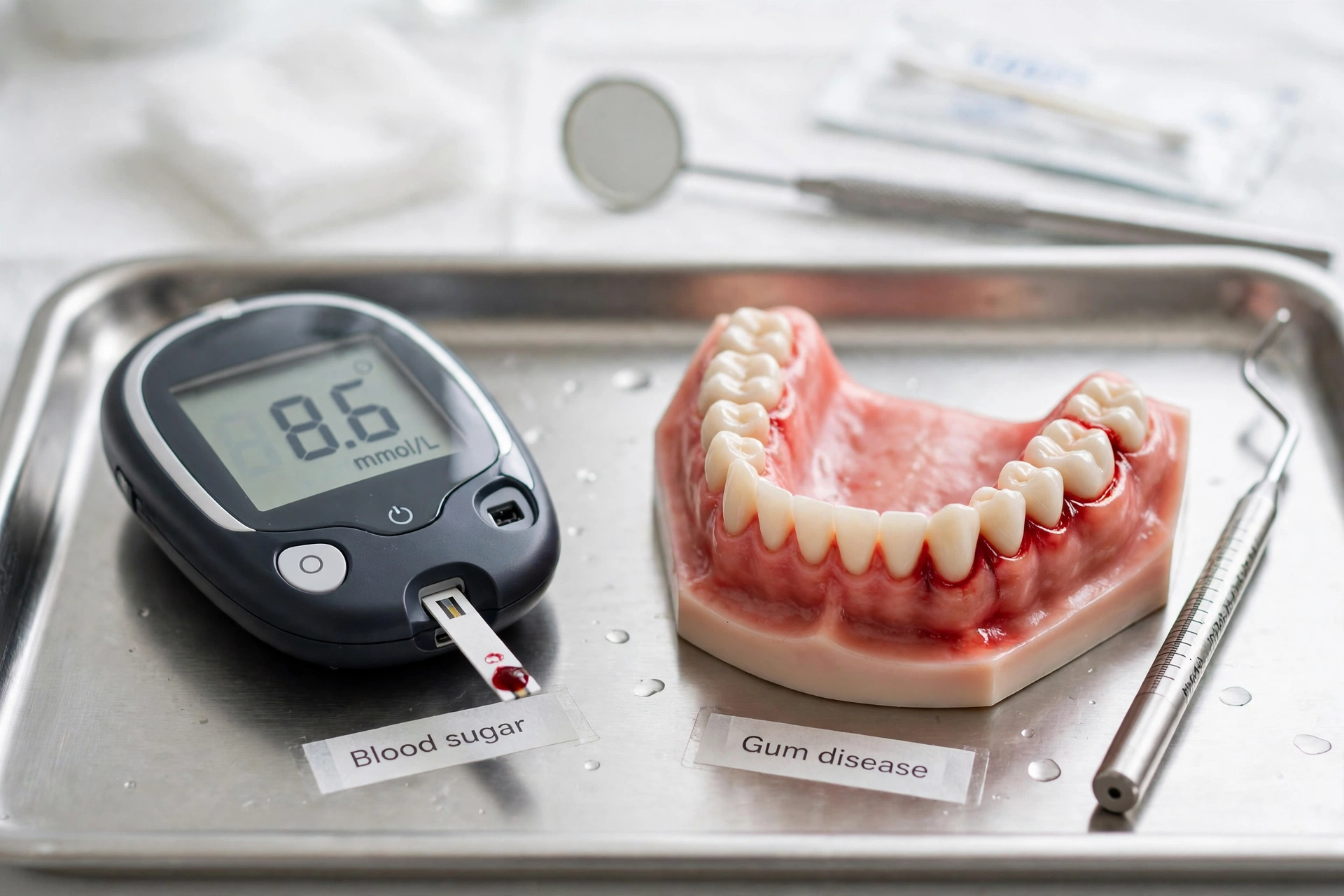
Diabetes and gum disease are linked in both directions. High blood sugar weakens the body's defences against the bacteria that cause gum disease, and it slows healing, so gum disease is more common and more severe in people with diabetes. Gum disease, in turn, keeps the body in a state of chronic inflammation, and that inflammation makes insulin work less well, so blood sugar becomes harder to control.
The American Diabetes Association, in its Standards of Care in Diabetes 2026, states the position plainly. Periodontal disease is more severe, and may be more prevalent, in people with diabetes than in those without, and it has been associated with higher A1C levels. Longitudinal studies suggest that people with periodontal disease have higher rates of new diabetes, which points to a bidirectional relationship. The same Standards say that people with diabetes should be referred for a dental exam at least once per year.
That once-a-year point matters, because it is a concrete action, not a vague warning. If you have diabetes and you have not seen a dentist in the past year, that visit is the single most useful next step in this guide.
The other number to hold on to is the A1C change after gum treatment. A 2013 Cochrane review found that non-surgical periodontal treatment reduced A1C by an average of 0.29 to 0.65 percent at 3 to 4 months after treatment. Other reviews report a similar range, around 0.4 to 0.6 percent. That is a real average across studies, and it is also a small one. It is roughly the size of change that a clinician would notice, not a cure, and it is an average, so any one patient may see more, less, or nothing at all. Keep that scale in mind whenever a headline promises more.
What A1C actually measures
A1C, also written HbA1c, is a blood test that measures the share of haemoglobin in your red blood cells that has glucose attached to it. Because red blood cells live for about 3 months, the result reflects your average blood sugar over roughly that period. It does not measure one morning's reading. It smooths out the good days and the bad days into a single average.
The CDC gives the diagnostic bands as follows.
| A1C result | What it means |
|---|---|
| Below 5.7 percent | Normal |
| 5.7 to 6.4 percent | Prediabetes |
| 6.5 percent or above | Diabetes |
| 7 percent or less | The general goal for most people with diabetes |
Three cautions belong with that table. First, a result in the diabetes range is normally confirmed, either by repeating the same test or by running a different one. One reading on its own is a data point, not a label. Second, the goal of 7 percent or less is for most people with diabetes, and individual targets differ by age, other conditions, and risk of low blood sugar. Your own target is the one your doctor sets with you. Third, A1C can be misleading in some situations, for example with certain blood conditions, so a clinician interprets it alongside your history and your medicines.
A dentist does not diagnose diabetes from your gums. A dentist can, however, be the first person to notice that your gums are not healing as they should, or that your gum disease is more severe than your home care would explain. That is a reason to ask about blood sugar, not a diagnosis.
How common is the problem
Gum disease is common, and diabetes makes it more common still. The CDC estimates that nearly half of adults aged 30 and over in the USA have some form of periodontal disease. That figure is for the general adult population. In people with diabetes, the disease tends to be more prevalent and more severe, according to the ADA Standards of Care 2026.
Diabetes itself is common too. The CDC reports that about 38 million Americans have diabetes, and about one in five of them does not know it. Another 97 million adults have prediabetes. Put those two common conditions together, and the overlap is large. Many people sitting in a dental chair have one or both, and many of them do not yet know about the diabetes side.
That overlap is why the link matters as a practical matter, not only as a piece of science. A dental visit is, for many adults, the most frequent health visit they actually attend. A dentist who knows about the diabetes, and a doctor who knows about the gums, can each do a better job than either one working alone.
Direction one: how diabetes makes gum disease worse
High blood sugar changes the mouth in several ways, and they add up.
First, it weakens the immune response. White blood cells do not fight infection as effectively when blood sugar is high, so the bacteria that live in dental plaque get more room to cause damage. Second, it damages small blood vessels, which reduces blood flow to the gums and slows healing after any injury or treatment. Third, it increases inflammation. The same high blood sugar that damages blood vessels elsewhere in the body also keeps gum tissue inflamed, which is the process that destroys the bone and tissue holding teeth in place.
There are also mouth-specific effects. Diabetes is associated with dry mouth, because high blood sugar can reduce saliva flow and some diabetes medicines also dry the mouth. Less saliva means less natural cleaning, more plaque, and a higher risk of cavities as well as gum disease. Diabetes is also associated with a higher risk of oral thrush, a fungal infection, and with slower healing after dental procedures.
The result, in clinical terms, is that periodontitis, the advanced form of gum disease, tends to be more severe in people with diabetes, and it tends to progress faster when blood sugar is poorly controlled. In plain terms, the same brushing and flossing routine may not be enough if blood sugar is high, and gum disease that would stay mild in another person may advance further in a person with diabetes.
| What diabetes does in the mouth | What it means for your gums |
|---|---|
| Weakens immune defences | Plaque bacteria cause more damage |
| Damages small blood vessels | Less blood flow, slower healing |
| Keeps inflammation high | Gum tissue and bone break down faster |
| Reduces saliva, causing dry mouth | Less natural cleaning, more plaque and cavities |
| Slows healing after treatment | Recovery after deep cleaning or surgery takes longer |
| Raises thrush risk | Sore, white patches that need treatment of their own |
None of this means gum disease is inevitable with diabetes. It means the margin for error is smaller, and regular professional cleaning and early treatment matter more, not less.
Direction two: how gum disease makes blood sugar harder to control
The other direction is less obvious, and it is the one most patients have never heard about.
Gum disease is a chronic infection. The gums are inflamed, often for months or years, and the bacteria in the gum pockets can enter the bloodstream in small amounts, especially during brushing, flossing, or chewing. The immune system responds to that steady low-level infection by staying activated. It releases inflammatory signals, including interleukin 1 beta, interleukin 6, and tumour necrosis factor alpha, into the bloodstream.
Those signals interfere with insulin. Insulin is the hormone that lets cells take up glucose from the blood. When inflammatory signals are high, cells respond less well to insulin, a state called insulin resistance. Blood sugar therefore stays higher than it would otherwise, and the same dose of diabetes medicine may work less well.
That is the mechanism behind the second half of the two-way link. It is also why studies find that severe periodontal disease is associated with higher A1C levels, and why longitudinal studies find higher rates of new diabetes in people with periodontal disease. The association runs in both directions, and the inflammation story is the most plausible explanation for the gum-to-blood-sugar direction.
Two cautions are needed here, and they are the same cautions as in our heart disease post. First, association is not proof of cause and effect in any one patient. Second, the fact that treating gum disease is followed by a small average fall in A1C does not prove that gum treatment alone will fix blood sugar. It is one factor among many, and blood sugar control still depends on diet, activity, weight, medicines, and the care of your doctor.
For the heart side of the same inflammation story, see our post Gum Disease and Heart Disease: What the December 2025 AHA Update Changed (and What It Did Not). The December 2025 AHA statement makes the same careful distinction there: association, not proven cause and effect. Our June 2025 post, What science says about the link between oral health and heart disease, explains the evidence as it stood before that update.
What gum disease looks like, stage by stage
Gum disease does not start with loose teeth. It starts quietly, and that is why it is often missed.
Gingivitis is the early stage. The gums are red, swollen, and bleed when you brush or floss. There is no bone loss yet, and gingivitis can be reversed with thorough cleaning and good home care. Periodontitis is the advanced stage. The gum pulls away from the tooth, pockets form, and the bone that holds the tooth starts to break down. Periodontitis cannot be reversed in the same way, but it can be treated and controlled, and early treatment makes a large difference to how much bone is lost.
The warning signs to watch for are bleeding gums, red or swollen gums, gums that pull away from the teeth, persistent bad breath, a bad taste in the mouth, teeth that feel loose or shift, and changes in how your teeth fit together when you bite. Pain is often absent until late, so waiting for pain is a poor strategy. If your gums bleed most days, that is worth mentioning at your next dental visit, and sooner if the bleeding is heavy or does not settle.
For the stages in more detail, and for what early treatment can save, see How can early remedy of gum illness save your smile.
What gum treatment can and cannot do
Treatment depends on the stage. For gingivitis, a professional cleaning and better home care are usually enough. For periodontitis, the standard treatment is scaling and root planing, a deep cleaning below the gum line that removes plaque and tartar from the tooth roots and smooths the root surface so the gum can reattach. More advanced cases may need surgical treatment, and your dentist or periodontist will explain the options for your case.
What the evidence says about blood sugar is specific. The Cochrane review found an average A1C fall of 0.29 to 0.65 percent at 3 to 4 months after non-surgical periodontal treatment. The ADA Standards of Care 2026 say that periodontal treatment using subgingival instrumentation, which is the technical term for that deep cleaning, may improve glycemic outcomes. "May improve" is the careful wording, and it is the right wording. The improvement is small on average, it is measured over months, and it is not a substitute for diabetes care.
What treatment cannot do is also worth stating plainly. It cannot diagnose diabetes. It cannot replace glucose-lowering medicine, diet, or activity. It cannot guarantee a lower A1C for you personally. And it cannot undo bone that has already been lost. What it can do is remove the infection that is driving inflammation, slow or stop further bone loss, and give your blood sugar control one less obstacle to work against.
If tooth loss has already happened, replacement options are a separate decision, and they interact with diabetes too, because healing after implant surgery depends on blood sugar control. Our post on Dental implants for seniors explains the cost, Medicare, and alternatives picture for older patients, and the healing point applies at any age.
The dental visit: what the ADA says, and what to expect
The ADA Standards of Care 2026 recommend that people with diabetes be referred for a dental exam at least once per year. That is the minimum. If you already have gum disease, your dentist will usually want to see you more often, often every 3 to 4 months for periodontal maintenance, until the disease is controlled.
A dental exam for a person with diabetes should include a full gum assessment, with pocket measurements around each tooth, a check for bleeding, and X-rays where needed to judge bone levels. It should also include a conversation about your diabetes, your medicines, and your blood sugar control. That conversation is part of the exam, not an extra.
Before a dental procedure, your dentist and your doctor may need to coordinate. The ADA Standards note that the medical and dental teams should coordinate to adjust glucose-lowering medication and treatment plans before and after dental procedures as needed. That matters most for longer or surgical procedures, and for patients whose blood sugar is poorly controlled or who take medicines that affect bleeding or healing. Tell both teams in advance, and do not change a diabetes medicine on your own because of a dental appointment.
If anxiety has kept you away from the dentist, that is common, and it is worth naming. Our post on Dental Anxiety? Nitrous Oxide vs Oral Sedation vs IV Sedation explains the options and the questions to ask before you book.
What to tell your dentist, and what to tell your doctor
This is the most useful part of the post, so it is written as two short lists you can use at your next visit.
Tell your dentist
- That you have diabetes, or prediabetes, and what type it is.
- Your most recent A1C, and the date it was measured, if you know it.
- Your diabetes medicines, including insulin if you use it, and any recent changes.
- Whether your blood sugar is usually well controlled or often high, in your own words.
- Any dry mouth, thrush, slow healing, or mouth sores you have noticed.
- Any heart condition, blood thinner, or other medicine that affects bleeding or healing.
- That you want a full gum assessment, including pocket measurements, not only a polish.
Tell your doctor
- That you have gum disease, and how severe your dentist says it is.
- Whether you have had deep cleaning or other gum treatment, and when.
- Whether your gums bleed often, or your teeth feel loose.
- That you have had a dental exam, and when the next one is due.
- Any dental surgery that is planned, so medicines can be coordinated in advance.
Bring the lists on your phone, or write them down. A two-minute exchange at the start of the visit can change what the clinician looks for, and it costs nothing.
A daily routine that helps both sides
No routine replaces professional treatment, but a steady home routine is what keeps treatment working after you leave the clinic.
Brush twice a day with fluoride toothpaste, for two minutes each time, and clean between the teeth once a day, with floss or an interdental brush, whichever your dentist recommends for your gaps. If your dentist has prescribed a mouthwash, use it as directed, and do not use it as a substitute for cleaning between the teeth. Drink water through the day if your mouth is dry, and mention persistent dry mouth to your dentist, because there are products that can help and medicines that can be reviewed.
Watch for bleeding. A little bleeding when you start flossing again after a gap is common, and it usually settles within a week or two of daily cleaning. Bleeding that does not settle, or gums that stay swollen, need a professional look, not a harder brush.
And keep the diabetes side in view. The same habits that help blood sugar, regular meals, activity, and taking medicines as prescribed, also help your gums, because they reduce the high blood sugar that drives the gum damage. The link runs both ways, so the care runs both ways too.
When to seek care sooner
Seek dental care sooner than your next routine visit if your gums bleed heavily or do not stop, if a tooth feels loose, if you have swelling in the face or gum, if you have a sore that does not heal within two weeks, or if you notice white patches that wipe off, which may be thrush. Seek medical care promptly if you have signs of very high blood sugar, such as extreme thirst, frequent urination, nausea, or confusion, or if you are unsure whether a mouth problem is affecting your diabetes control. In an emergency, seek urgent care rather than waiting for a routine appointment.
Frequently asked questions
Does diabetes cause gum disease?
Diabetes does not cause gum disease on its own. Gum disease is caused by plaque bacteria. Diabetes makes gum disease more likely, more severe, and harder to heal, because high blood sugar weakens immune defences, damages small blood vessels, and keeps inflammation high. The relationship is a two-way association, not a simple one-way cause.
Can treating gum disease lower my A1C?
On average, in studies, yes, by a small amount. A Cochrane review found an average fall of 0.29 to 0.65 percent at 3 to 4 months after non-surgical periodontal treatment. That is an average across studies, not a promise for any one patient, and gum treatment does not replace diabetes medicine, diet, or activity.
How often should I see the dentist if I have diabetes?
The ADA Standards of Care 2026 recommend a dental exam at least once per year for people with diabetes. If you already have gum disease, your dentist will usually want to see you more often, often every 3 to 4 months, until the disease is controlled.
What A1C level should I aim for?
There is no single target for everyone. The CDC gives a general goal of 7 percent or less for most people with diabetes, and the diagnostic bands are below 5.7 percent for normal, 5.7 to 6.4 percent for prediabetes, and 6.5 percent or above for diabetes. Your own target is the one your doctor sets with you.
Can a dentist tell if I have diabetes?
No. A dentist cannot diagnose diabetes from your gums. A dentist can notice gum disease that is more severe than expected, or healing that is slower than expected, and suggest that you ask your doctor about a blood sugar check. Diagnosis is by blood test, interpreted by a clinician.
Is dry mouth part of diabetes?
Dry mouth is associated with diabetes, and it can also be a side effect of some medicines. Less saliva means more plaque and a higher risk of cavities and gum disease. Mention persistent dry mouth to your dentist and your doctor, and do not simply drink sugary drinks to fix it, because those raise blood sugar further.