



You wake up with a sore jaw, or your dentist points at flattened teeth and says you grind at night. The next question is money: what does a night guard cost, and is the expensive one worth it? The short answer is that a custom guard from a dentist typically costs $300-$800 in the USA in 2026, an online custom guard costs $100-$200, and a drugstore boil-and-bite guard costs $15-$40. The right choice depends on how hard you grind, not only on price, and the cheapest guard is not always the cheapest per year.
This guide is written for a patient in the USA who has been told they grind or clench their teeth, or who suspects it from the signs. It explains what a night guard actually does, the three ways to buy one and what you pay for each, why the dentist version costs what it does, when the cheap guard is enough and when it is a false economy, what insurance will and will not pay, how long each type lasts and what it costs per year, and how to look after it.
One line to hold through the whole guide: a night guard protects your teeth, it does not stop you grinding. That is the most important thing to understand before you spend anything, because anyone who sells a guard as a cure for grinding is overselling it.
The short answer
A custom night guard from a dentist typically costs $300-$800 in the USA in 2026. An online custom guard, made from an impression you take at home and mail in, costs $100-$200. A drugstore boil-and-bite guard costs $15-$40. A dental school clinic is a fourth route, usually $100-$250, with supervised students and a slower appointment.
The price bands are wide because the price depends on the material, the provider, the region and your insurance. A hard acrylic guard in a major city commonly costs $600-$800. The same kind of guard in a smaller market is nearer $300. A dual-laminate guard, hard on the outside and soft on the inside, is often $500-$800. Specialist devices for TMJ problems or sleep apnea cost $600-$900 or more, and they are a different product from a standard night guard.
The choice is not only about the price on the day you buy it. A custom guard lasts 3-5 years, and some guides say 3-10 years. A boil-and-bite guard lasts 3-6 months. Worked out per year, the expensive guard can cost about the same as the cheap one, and it protects far better. That calculation is in the cost-per-year section below.
TL;DR: the three bands at a glance
| Route | Typical cost in 2026 | How it is fitted | Lasts about |
|---|---|---|---|
| Drugstore boil-and-bite | $15-$40 | You soften it in hot water and bite into it at home | 3-6 months |
| Online custom (mail-in impression) | $100-$200 | You take an impression at home and mail it to a lab | 1-3 years |
| Dentist custom | $300-$800 | Impression or digital scan in the clinic, lab made, fitted and adjusted in person | 3-5 years, some guides say 3-10 |
| Dental school clinic | $100-$250 | Supervised students, slower appointments | 3-5 years |
The one-line rule: mild, occasional clenching with healthy teeth, a drugstore guard is a reasonable first test. Heavy grinding, existing wear, or crowns, veneers or implants to protect, get a custom guard.
What does a night guard actually do, and when do you need one?
A night guard is a removable appliance that sits over the biting surfaces of your teeth while you sleep. It puts a layer of plastic between your upper and lower teeth, so the grinding force lands on the guard instead of on your enamel. It spreads the force, it stops tooth against tooth contact, and it gives your jaw muscles a smoother surface to slide on. What it does not do is stop the grinding itself. The habit continues. The damage does not, or not as fast.
That distinction matters because it changes what to expect. If you buy a guard hoping your jaw will stop hurting in a week because you stopped grinding, you will be disappointed. If you buy it to protect your teeth from further wear while you and your dentist work on the causes, it does its job. A long-term cohort study in Clinical Oral Investigations (2023) followed 598 root-canal-treated teeth in 312 patients and found that wearing a night guard was a protective factor for tooth survival. That was one cohort of treated teeth, not a trial in the general population, and it does not show whether the grinding itself lessened. It shows the protection side, which is what a guard is for.
The signs that you may need one are usually noticed by someone else first. Your dentist sees flattened biting surfaces, chipped enamel, or cracked fillings. Your partner hears grinding at night. You wake up with a sore jaw, a dull headache, or teeth that feel sensitive in the morning. A tooth can crack, a crown can break, or a filling can come loose. Grinding can also strain the jaw joint, the temporomandibular joint, which connects the jaw to the skull, and that can bring jaw pain and clicking.
Our earlier post on what grinding does to teeth sets out the damage in detail: 12 Methods Tooth Grinding Can Destroy Your Oral Well being. The short version is that untreated grinding wears enamel down, exposes dentine, cracks teeth, loosens restorations and strains the jaw joint, and it does all of it quietly, over years, while you sleep.
Not everyone who grinds needs a guard at once. A dentist usually recommends one when there is visible wear, when teeth or restorations are breaking, when jaw pain is regular, or when there is expensive work to protect. If you grind lightly, have no wear and no pain, your dentist may suggest watching and waiting, and checking again at your next visit. The decision is a clinical one, and it starts with an examination, not with a shopping page.
The three ways to buy one, and what you pay for each
There are three main routes, plus the dental school option. They differ in price, in fit, and in what happens when something goes wrong.
Drugstore boil-and-bite, $15-$40. You buy a guard off the shelf, soften it in hot water, and bite into it to shape it to your teeth. It is ready the same day, it costs the least, and it is bulky. The fit is approximate, because you are shaping it yourself, and it wears out in 3-6 months. Some stock guards cost up to $15-$100. The wider range covers thicker sports-style guards that are not really night guards. For a first test, or for a short trip, it is a reasonable start. For heavy grinding, it is usually too soft and too thick, and it can make jaw pain worse if it changes your bite.
Online custom, $100-$200. You order a kit, take an impression of your teeth at home with putty, mail it to a lab, and the lab makes a guard from your impression. The fit is far better than a boil-and-bite guard, because it is made from your teeth, and the material is usually the same hard acrylic or dual-laminate a dental lab uses. The wider range is $75-$400, depending on material and thickness, and lab-price checks in Sep 2026 put typical examples at $109.99-$179.99. What you do not get is a dentist. Nobody checks your bite, nobody adjusts the guard in your mouth, and nobody tells you whether the guard is the right treatment for your jaw. If the impression is poor, the guard will be poor, and you may not know why.
Dentist custom, $300-$800. Your dentist takes an impression or a digital scan in the clinic, sends it to a lab, and then fits the guard in your mouth and adjusts it. The wider range is $300-$1,000, with hard acrylic at $600-$1,000 and dual-laminate at $500-$800 in one lab-price compilation. Major-city fees of $600-$800 are common, and smaller markets are nearer $300. What you are paying for is mostly the fitting and the follow-up, not the plastic. That is the subject of the next section.
Dental school clinic, $100-$250. A dental school clinic offers the same custom guard, made by supervised students, for roughly half to 60 percent less than a private practice, according to one Oct 2026 guide. Appointments are slower, because students work under supervision and each step is checked, but the guard itself is a proper custom appliance. If cost is the barrier and you can wait, this is the best value route in this guide.
| Route | Typical cost | Fit process | Main tradeoff | Lifespan |
|---|---|---|---|---|
| Drugstore boil-and-bite | $15-$40 | Self-fitted at home in hot water | Bulky, approximate fit, wears fast | 3-6 months |
| Online custom | $100-$200 | Home impression mailed to a lab | Good fit, no chairside check or adjustment | 1-3 years |
| Dentist custom | $300-$800 | Clinic impression or scan, lab made, fitted and adjusted in person | Best fit and follow-up, highest price | 3-5 years, some guides say 3-10 |
| Dental school clinic | $100-$250 | Supervised students, slower appointments | Best value, needs patience | 3-5 years |
Why does the dentist version cost $300-$800?
The plastic in a custom guard costs very little. The price is in the work around it, and that work is what makes the guard fit and last.
First, the impression or the digital scan. A dentist takes a full impression of one or both arches, or scans your teeth with an intraoral scanner, and checks that the record is accurate. A poor impression makes a poor guard, and a dentist can retake it on the spot. A home impression kit cannot.
Second, the lab. The dentist usually sends the impression to a dental lab, where a technician makes the guard from hard acrylic, soft material or dual-laminate, to the thickness your dentist prescribes. The material choice matters: hard acrylic lasts longest and is best for heavy grinding, soft material is more comfortable but wears faster, dual-laminate tries to do both. Your dentist chooses the material for your bite, not from a shopping list.
Third, the fitting. When the guard comes back, your dentist checks it in your mouth, adjusts the bite so your teeth meet evenly on it, and trims any edge that rubs your cheek or tongue. This is the step an online guard skips, and it is the step that decides whether you can actually wear the guard every night. A guard that is too high on one side, or that rocks, will end up in a drawer.
Fourth, the follow-up. A dentist usually sees you again after a few weeks to check the wear pattern on the guard, which shows where you grind hardest, and to adjust it again. If your bite changes, or you have dental work done, the guard can be adjusted or relined. That ongoing care is part of the price, and it is why a dentist guard lasts 3-5 years instead of 3-6 months.
None of this means the dentist route is right for everyone. It means the $300-$800 is not a markup on a piece of plastic. It is the price of a fitted, adjusted, followed-up appliance, and if you do not need that level of care, you should not pay for it. The next section is about when you do and when you do not.
When is the cheap guard enough, and when is it a false economy?
A drugstore guard is enough when the grinding is mild and occasional, your teeth are healthy, you have no crowns, veneers or implants to protect, and you have no jaw pain. In that case, a $15-$40 guard is a reasonable first test. Wear it for a few weeks. If your jaw feels better in the morning and the guard shows light wear, it is doing its job. If it feels bulky, makes you gag, or gives you a sore jaw, stop and talk to your dentist, because a badly fitting guard can change your bite.
A cheap guard is a false economy when the grinding is heavy. The signs of heavy grinding are flattened teeth, enamel worn down to dentine, cracked teeth or broken fillings, and morning jaw pain that does not ease. In that case a soft boil-and-bite guard wears through in weeks, not months, and while it is wearing through, your teeth are still taking the force. You replace it three or four times a year, and you still have no proper fit and no one checking your bite.
The case for a custom guard is strongest when there is expensive work to protect. A crown, a veneer or an implant costs far more than a guard, and grinding is one of the fastest ways to break them. If you have implant work, the stakes are higher still, because an implant has no ligament to absorb force the way a natural tooth does. The cost picture for implants, including what Medicare does and does not pay, is in our seniors guide: Dental Implants for Seniors Over 65 in the USA in 2026. A $600 guard that protects a $4,500 implant is not an expensive guard.
An online custom guard sits in the middle. It is the right choice when you grind moderately, you have healthy teeth and no jaw pain, you cannot afford or cannot reach a dentist custom guard, and you are confident taking a good impression at home. It is the wrong choice when you have jaw pain, clicking or locking, when your bite is already uneven, or when you need the guard to protect new crowns, veneers or implants. In those cases the chairside fitting is the point, and skipping it saves money in the wrong place.
What will insurance pay?
This is the section where most people are disappointed, so here is the honest picture. Many dental plans do not cover night guards at all. Many plans that do cover them pay only part of the cost, and they apply the payment against your annual maximum, which leaves less for everything else that year.
When a plan does cover a night guard, it usually classifies it under Major Restorative or Prosthetics, at about 50 percent after a deductible, when bruxism is documented. That “about 50 percent” is a typical figure from 2026 guides, not a promise, and it varies by plan. Coverage usually needs a documented bruxism diagnosis in the clinical record, and some plans need pre-authorisation. There is usually a frequency limit, commonly one guard every 3-5 years, and the annual maximum still caps the payment. On a $600 guard, 50 percent after a deductible is about $300, minus the deductible, and only if the annual maximum has room left.
The billing codes are worth knowing, because they are what appears on your paperwork. The American Dental Association’s CDT codes for occlusal guards are D9944 for a hard guard covering a full arch, D9945 for a soft guard covering a full arch, and D9946 for a hard guard covering only part of an arch. D9940 is the older code for a hard full-arch guard, now replaced by D9944, and it still appears on some paperwork. If your plan asks what was done, those are the codes to quote. A guard prescribed for a jaw joint disorder rather than for bruxism may be coded differently, and that is a question for your dentist, because using the wrong code is a common reason for a denial.
Before you buy, ask your plan three things in writing: the code, the benefit category, and the replacement limit. The code tells you whether the plan recognises the guard at all. The benefit category tells you the percentage and whether it counts against the annual maximum. The replacement limit tells you how often the plan will pay for a new one. If the plan cannot answer in writing, that is itself an answer.
The same fine-print thinking applies to the rest of your dental cover. Our guide to dental insurance with no waiting period for implants explains how first-year rates, annual maximums and the missing tooth clause decide what an implant costs, and the same three numbers shape a night guard claim too: Dental Insurance With No Waiting Period for Implants in the USA: How to Read the Fine Print.
Two other ways to pay are worth knowing. A custom night guard prescribed for diagnosed bruxism is generally treated as a qualified medical expense under the IRS Publication 502 framework, so it is usually HSA and FSA eligible. That is not an IRS ruling on night guards by name, and your plan administrator decides, so keep the prescription and the itemised receipt, and ask your administrator before you spend. And some practices offer payment plans for a custom guard, which spreads the $300-$800 over a few months. Ask before you assume, because not every practice offers one.
How long does each type last, and what does it cost per year?
A custom guard from a dentist lasts 3-5 years in most guides, and some guides say 3-10 years. An online custom guard lasts 1-3 years, depending on the material and how hard you grind. A boil-and-bite guard lasts 3-6 months. A dental school guard lasts about as long as a dentist guard, 3-5 years, because it is the same kind of appliance.
The lifespan matters more than the price tag, because a guard you replace every few months is not cheap. Here is the worked example, with illustrative figures, not a quote.
Take one heavy grinder. A dentist custom guard costs $600 and lasts 3 years. That is about $200 a year. A boil-and-bite guard costs $50 and needs replacing every 4 months, which is 3 guards a year, about $150 a year. The cheap option saves about $50 a year, and in exchange you get a bulky fit, no bite check, no adjustment, and a guard that wears through while your teeth take the force. Over 3 years the dentist guard costs about $600 in total and the boil-and-bite route costs about $450, and the dentist guard protects far better. That is why the cheap guard is not always cheaper.
The same maths runs the other way for a mild grinder. If you grind lightly and a $30 boil-and-bite guard lasts 6 months, that is about $60 a year, against about $200 a year for a dentist guard. In that case the cheap guard really is cheaper, and it is enough, because there is little force to absorb. The right question is not “which guard is cheapest” but “how hard do I grind, and what am I protecting”.
A note on timing, for the insurance section above: if your plan pays for one guard every 3-5 years, time the replacement to the plan’s limit, not to the calendar. A guard that is wearing thin at year 3 is a good time to claim, and a guard that is still sound at year 3 is not a reason to replace it early.
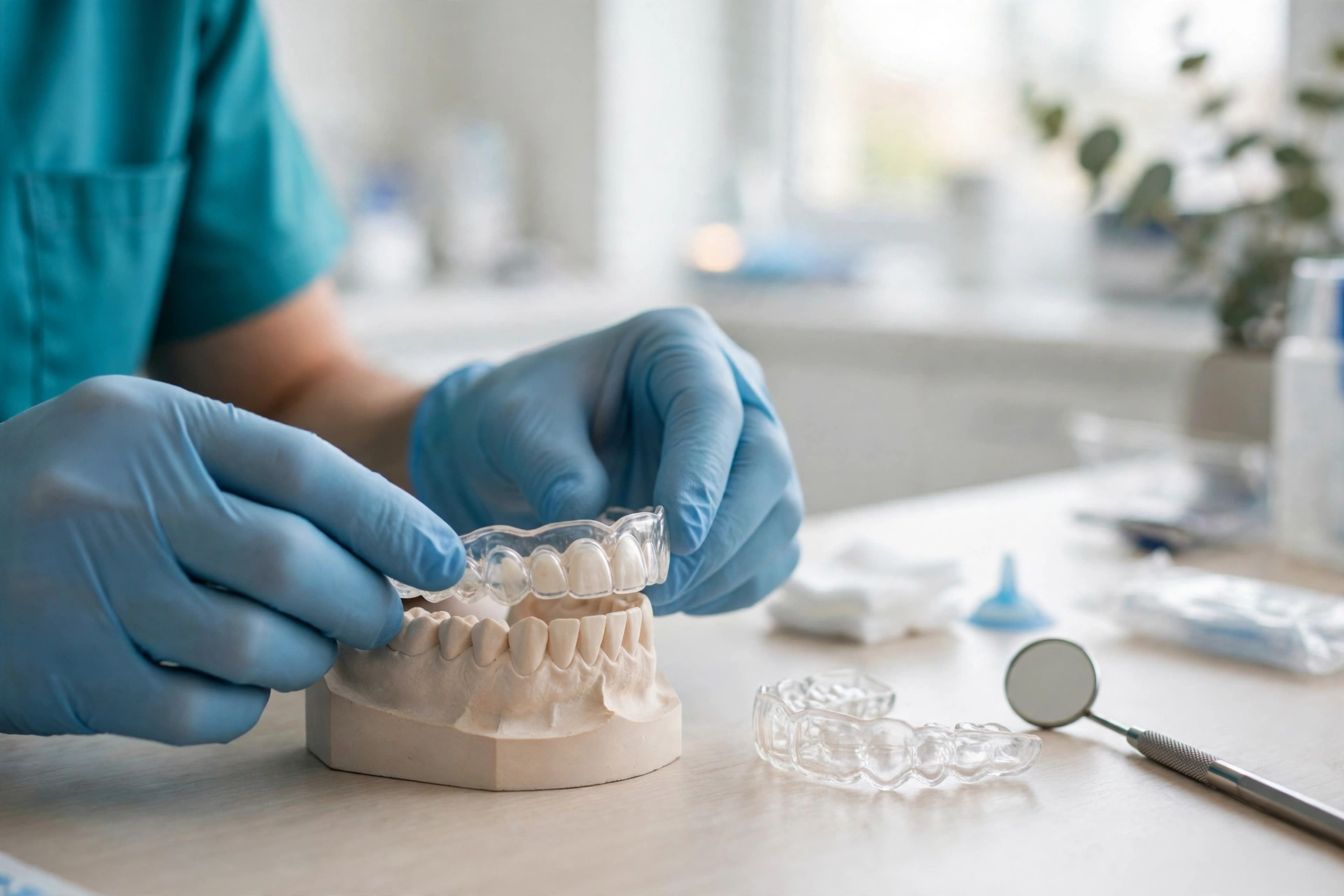
How to care for it, and when to replace it
A night guard lasts longer if you look after it, and the care is simple. Rinse it under cold or lukewarm water every morning, brush it gently with a soft toothbrush and plain soap or a non-abrasive cleaner, and let it air dry before you put it away. Do not use hot water, because heat can warp it, and do not use toothpaste with abrasive whitening particles, because it scratches the surface and gives bacteria places to hide. Store it in its case, dry, away from heat and away from pets, because dogs love to chew night guards.
Soak it occasionally in a denture cleaner or a guard cleaning tablet, following the product’s instructions, and check it each week for wear. The signs that it needs replacing are holes worn through the biting surface, cracks, a fit that has gone loose, a smell or taste that does not go away after cleaning, or a bite that feels different when you wear it. If you have dental work done, a new crown, a filling, or an extraction, take the guard to your dentist, because your bite has changed and the guard may no longer fit.
Bring the guard to every dental checkup. Your dentist can read the wear pattern on it, which shows where you grind hardest, and can adjust it or tell you it is time for a new one. A guard that is wearing evenly is doing its job. A guard that is wearing through in one spot is telling your dentist something about your bite.
When to see a dentist sooner
Book a visit sooner than your next routine checkup if you notice any of these: a cracked or chipped tooth, a crown or filling that has broken or come loose, jaw pain that does not ease, jaw clicking or locking, morning headaches that are getting worse, or a guard that no longer fits after dental work. None of these proves the guard caused the problem. Each of them is a reason to look, rather than to wait.
If grinding has already damaged teeth and the repair work is extensive, and you feel anxious about dental visits, it is worth knowing that sedation options exist for restorative work. The questions to ask before you book are in our guide on Dental Anxiety: Nitrous Oxide vs Oral Sedation vs IV Sedation. Read it before you put off the repair, because delay is usually what turns a small crack into a lost tooth.
If you grind and you also snore loudly, wake up gasping, or feel tired during the day despite a full night’s sleep, tell your dentist and your doctor. Grinding and sleep apnea often appear together, and a standard night guard is not a sleep apnea device. Sleep apnea appliances are a different product, with different codes and a different fitting, and they are prescribed after a sleep study.
The bottom line
A night guard costs $15-$40 from a drugstore, $100-$200 online, and $300-$800 from a dentist in the USA in 2026, with a dental school clinic at $100-$250. The price is only half the decision. The other half is how hard you grind and what you are protecting. Mild grinding with healthy teeth, a drugstore guard is a reasonable first test. Heavy grinding, visible wear, or crowns, veneers or implants to protect, a custom guard is the right buy, and worked out per year it costs about the same as replacing cheap guards.
Remember what a guard does and does not do. It protects your teeth, it does not stop you grinding. Buy the guard for the protection, keep the receipt and the prescription for your HSA or FSA, ask your plan for the code, the benefit category and the replacement limit in writing, and bring the guard to every checkup so your dentist can read the wear on it. The goal is not the cheapest guard. It is the guard you will actually wear every night, for years, while your teeth stay intact.
Frequently asked questions
How much does a custom night guard cost in the USA in 2026?
A custom night guard from a dentist typically costs $300-$800 in the USA in 2026, with major-city fees commonly $600-$800 and smaller markets nearer $300. The wider range is $300-$1,000, with hard acrylic at $600-$1,000 and dual-laminate at $500-$800 in one lab-price compilation. An online custom guard costs $100-$200, and a drugstore boil-and-bite guard costs $15-$40. All figures are typical ranges, not quotes, and they vary by provider, region, material and insurance.
Is a night guard covered by dental insurance?
Often not, or only partly. Many plans exclude night guards entirely. Plans that do cover them usually classify the guard under Major Restorative or Prosthetics at about 50 percent after a deductible, when bruxism is documented, and the payment counts against the annual maximum. There is usually a frequency limit, commonly one guard every 3-5 years. Ask your plan for the code, the benefit category and the replacement limit in writing before you buy, and do not assume coverage.
Can I use HSA or FSA funds for a night guard?
Usually, yes, for a custom guard prescribed for diagnosed bruxism. A custom night guard prescribed for bruxism is generally treated as a qualified medical expense under the IRS Publication 502 framework, so it is usually HSA and FSA eligible. That is not an IRS ruling on night guards by name, and your plan administrator decides, so keep the prescription and the itemised receipt, and ask your administrator before you spend.
Is an online night guard as good as one from a dentist?
The material can be the same, but the fitting is not. An online custom guard is made from an impression you take at home, and nobody checks your bite, adjusts the guard in your mouth, or tells you whether a guard is the right treatment for your jaw. For moderate grinding with healthy teeth and no jaw pain, an online guard is a reasonable middle option. For heavy grinding, jaw pain, an uneven bite, or crowns, veneers or implants to protect, the chairside fitting is the point, and a dentist guard is the better buy.
How long does a night guard last?
A custom guard from a dentist lasts 3-5 years in most guides, and some guides say 3-10 years. An online custom guard lasts 1-3 years. A boil-and-bite guard lasts 3-6 months. Replace the guard when it has holes worn through the biting surface, cracks, a loose fit, or a smell that does not go away after cleaning, or after dental work that changes your bite.
Will a night guard stop me grinding my teeth?
No. A night guard protects your teeth from the force of grinding, it does not stop the grinding itself. The habit continues, and the damage slows or stops. If your goal is to reduce the grinding, talk to your dentist about the causes, which can include stress, sleep problems and some medicines, and about whether a different appliance or a referral is needed. Do not buy a guard expecting a cure.
This article is general information, not medical advice and not insurance advice. Dental plan terms vary by state and change every year. The policy document is the only binding source of what a plan covers. Get a written predetermination of benefits before treatment starts, and discuss the treatment plan, including any jaw pain or sleep symptoms, with your dentist.