



The direct answer
Bone loss does not usually rule out dental implants. It changes the plan, the price and the timeline. If a tooth has been missing for months or years, the jawbone underneath it shrinks, because bone that has no tooth root to hold stops getting the pressure that keeps it alive. A dentist first measures what is left with a 3D scan. Then, depending on how much bone remains and where it is, the path is usually one of four: a bone graft to rebuild the foundation first, a sinus lift for the upper back teeth, a different implant design that uses the bone that is still there, or a different replacement altogether, such as a bridge or a denture. Only a small group of cases, severe bone loss plus a health problem that stops healing, ends with implants not being possible at all.
This guide covers the USA in 2026: how fast bone disappears, what each fix costs, how long each one takes to heal, and the questions that tell you whether a quote is complete. Every price is a typical US range, not a quote, and it varies by provider, region, tooth and insurance.
Why bone disappears after a tooth is lost
A tooth root does more than hold the tooth in place. Every time you bite, the root passes pressure into the jawbone, and that pressure tells the bone to keep renewing itself. Take the tooth away and the signal stops. The body starts to resorb the bone, which means it slowly breaks it down and carries it away. The ridge, the raised band of bone that held the tooth, gets narrower and shorter. The outer wall, the side you see when you smile, is thinner than the inner wall, so it shrinks first, and that is why a long-missing tooth can change the shape of the face over time.
Gum disease speeds the same process up while the tooth is still there. Infection around a root destroys the bone that supports it, which is why a tooth lost to gum disease often leaves less bone behind than a tooth lost to a clean fracture. Dentures make it worse, not better. A removable denture sits on top of the ridge and presses on it, and guides report that denture wearers can lose 25-50 percent of jawbone width in the first few years after tooth loss. A bridge does not stop it either. A bridge rests on the neighbouring teeth and leaves the gap underneath empty, so the bone under the gap still shrinks. Only an implant, or a graft that rebuilds bone for an implant, puts pressure back into the bone.
How fast it happens
The loss is fastest early, and that is the part most people miss. It does not wait a year and then start. It starts immediately, and most of the first year loss happens in the first three months.
| Time after extraction | What the studies report |
|---|---|
| First 3 months | About two-thirds of the first year loss happens here. Width loss of 2-4 mm is common in this phase. |
| First 6 months | Horizontal (width) loss of 29-63 percent, averaging about 3.79 mm. Vertical (height) loss of 11-22 percent, averaging about 1.24 mm. |
| First 12 months | Up to 50 percent of the original ridge width may be gone. |
| After year one | Loss slows to about 0.5-1 percent per year, and it does not stop. |
These numbers come from a systematic review by Tan and colleagues, published in Clinical Oral Implants Research in 2012, which analysed 20 clinical studies. Other reviews give slightly different figures because they measure different patients in different ways, which is why this guide uses ranges and names the source. The widely quoted shorthand, that you can lose up to 25 percent of bone width in the first year, sits inside the same range. The practical point is the same whichever study you read: waiting is not free. A tooth replaced within months usually needs little or no grafting. The same tooth replaced after five years often needs a graft, a sinus lift, or a different implant design entirely.
That is also why a socket preservation graft, done at the time of extraction, is the cheapest bone work you will ever buy. It is covered in the next section.
How a dentist measures what is left
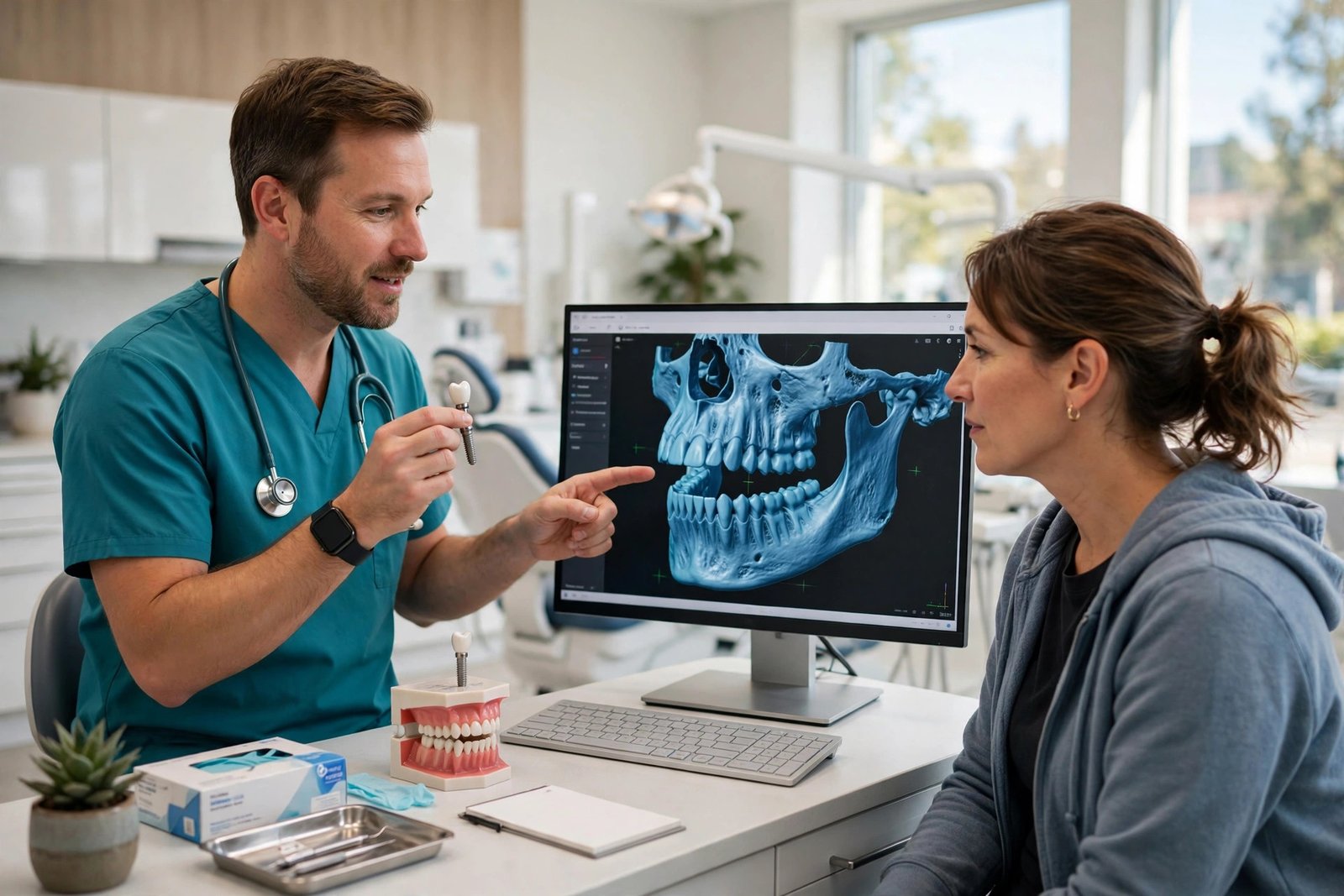
A flat X-ray is not enough for this decision. It shows height, but it does not show width, and width is usually what is missing. The standard tool is a 3D CBCT scan, a cone beam CT that builds a three-dimensional picture of the jaw. It shows how much bone height and width remain, where the sinus floor sits in the upper jaw, where the nerve runs in the lower jaw, and how dense the bone is. A scan costs about $150-$400 when it is billed separately, and many implant offices include it in the consultation or the treatment quote. Ask before you book whether the scan is included, because a quote that leaves it out is not a complete quote.
Two numbers decide the plan. The first is height. Most upper back implants need at least 8-10 mm of bone height. If the sinus floor leaves less than that, a sinus lift is the fix. The second is width. A standard implant needs about 6-7 mm of ridge width to sit safely with bone on both sides. If the ridge is narrower, a ridge graft rebuilds the width first. Your dentist will also check the gum, whether any infection is still present, and whether you grind your teeth at night, because a graft and an implant both heal worse under constant grinding pressure. Our guide to night guard costs explains the options if grinding is part of your picture: Night Guard Cost in the USA in 2026: Dentist vs Online vs Drugstore.
Option 1: socket preservation, the graft done at extraction
Socket preservation is a small bone graft placed into the empty socket on the same day the tooth comes out. The graft material, usually donated human bone, animal-derived bone, or a synthetic mineral, fills the socket so the walls do not collapse inward as they heal. A membrane is often placed over the top to hold it in place. The point is not to grow a perfect new ridge. It is to lose less bone while you decide what comes next.
It costs about $250-$1,200 per site in 2026 guides, and it is the least expensive graft because the socket is already open and no second surgery is needed. The CDT code is D7953. Healing takes a few months, and it does not guarantee that an implant will fit without further work, but studies that compare sockets with and without preservation find meaningfully less width loss with it. If you know you want an implant later but you are not ready for the implant itself, this is the single best-value step in this whole guide. If the tooth is already gone, this option has passed, and the next two are the ones that matter.
Option 2: ridge augmentation, rebuilding width or height
Ridge augmentation is the general name for rebuilding a jaw ridge that has already shrunk. There are two common forms. A ridge preservation graft after extraction is the small one above. A ridge augmentation months or years later is the bigger one: the surgeon opens the gum, places graft material where the bone is missing, covers it with a membrane, and closes the gum over it. A block graft, a solid piece of the patient’s own bone or donated bone fixed in place with a small screw, is used for the largest defects.
It costs about $500-$3,000 per site in 2026 guides, with larger and more complex cases higher, and the wider national range across graft types runs $250-$3,500. The CareCredit cost study gives an average of $811 for an allograft. Graft material and the membrane are sometimes billed separately, and they can add $200-$800, so ask whether the quote includes them. Healing takes about 3-6 months before an implant can be placed, because the graft has to turn into living bone first. A graft that is loaded too early, by an implant placed before it has matured, is the most common avoidable reason a graft fails.
The material matters less than most patients expect. Your own bone heals fastest but needs a second surgical site, usually the chin or the back of the jaw, to take it from. Donated human bone and bovine bone avoid that second site and are the most common choice in the USA. Synthetic minerals are the third option. Your surgeon will pick based on the size of the defect and your health, not on brand names. What matters is that the graft is given its full healing time, and that smoking stops during healing, because smoking roughly doubles the failure rate of grafts and implants alike.
Option 3: sinus lift, adding height in the upper back jaw
A sinus lift is a bone graft in one specific place: the upper back jaw, under the maxillary sinus. When the upper back teeth have been missing for a while, two things happen at once. The bone shrinks from below, and the sinus floor drops from above. The result is a thin shelf of bone, often 4 mm or less, where an implant needs 8-10 mm. A sinus lift gently raises the thin membrane that lines the sinus floor and packs graft material underneath it. Over months, that graft becomes new bone, and the implant goes into it.
There are two approaches, and the price and the wait depend on which one you need.
A crestal lift, also called an internal lift, goes through the same small hole prepared for the implant. It is the smaller procedure, for a small gain in height, usually 2-4 mm, and the implant is usually placed at the same appointment. It costs about $500-$1,500, often $800-$1,500, and it heals together with the implant over 3-6 months. There is no separate wait.
A lateral window lift opens a small window in the side of the jaw to reach the sinus. It is the larger procedure, for severe bone loss, often less than 4-5 mm of residual height, and it usually needs a separate healing period before the implant goes in. It costs about $1,500-$3,500 as a standalone procedure, with wider guides running $1,500-$4,500, and Pearl’s ADA-based data gives a national average of $2,260 and a typical range of $1,470-$3,860. The graft needs 4-9 months to mature before the implant is placed. If at least 4-5 mm of bone remains, the implant can sometimes be placed at the same surgery, but that is a judgement your surgeon makes from the scan, not a promise.
Recovery from a sinus lift is usually moderate swelling and discomfort for 5-7 days, managed with prescription pain medicine at first and then over-the-counter ibuprofen. For 2-3 weeks the rules are specific: do not blow your nose, do not drink through a straw, sneeze with your mouth open, and avoid flying, scuba diving and swimming underwater, because air pressure changes can disturb the membrane while it heals. Those rules sound fussy, and they are the whole recovery. Follow them and a sinus lift is a routine procedure. Ignore them and the membrane can tear, which is the most common complication, and the one that adds months to the timeline.
What it all costs, on one page
| Treatment | Typical US range, 2026 | When you need it |
|---|---|---|
| Socket preservation graft, at extraction | $250-$1,200 per site | Tooth just removed, implant planned later |
| Ridge augmentation | $500-$3,000 per site | Ridge already too narrow or too short |
| Sinus lift, crestal (with implant) | $500-$1,500 | Upper back tooth, small height gain needed |
| Sinus lift, lateral window (standalone) | $1,500-$4,500 per side | Upper back tooth, severe height loss |
| Single implant, all-in (post, abutment, crown) | $3,000-$6,000 | The implant itself, after the foundation is ready |
| All-on-4, per arch | $15,000-$30,000 | Full arch, moderate to severe bone loss |
| Zygomatic implants, total | $30,000-$60,000 | Full upper arch, severe bone loss, grafting not enough |
Graft material and membrane can add $200-$800, and a 3D CBCT scan $150-$400, when billed separately. Sedation is separate too. All figures are typical US ranges, not quotes, and they vary by provider, region, tooth and insurance.
A worked example makes the ranges concrete. Take one upper molar, missing for three years, with 4 mm of bone under the sinus. The lateral window path is a sinus lift at about $2,000 plus a single implant all-in at about $4,500, about $6,500 before insurance, plus a 4-9 month wait between the lift and the implant. The same tooth with 7 mm of bone could take the crestal path: a lift at about $1,000 done at the same appointment as the implant, plus the same $4,500 implant, about $5,500, with no separate wait. The difference is not the dentist. It is the millimetres on the scan, which is why two patients with the same missing tooth can get quotes $1,000 apart and both be right.
For the wider decision, including whether to save a tooth at all instead of replacing it, read our comparison of the two paths: Root Canal vs Extraction and Implant: Cost, Pain, and How to Decide in 2026.
Option 4: skipping the graft, the graftless designs
Not every case needs a graft. Implant design has moved a long way, and three graftless options now cover many of the cases that used to need one.
Short implants are shorter than standard ones, for limited bone height. Narrow implants, sometimes called mini implants, are thinner, for limited bone width. They are not a shortcut for every case, and they carry less load than a standard implant, so they suit single small teeth and denture stabilisation more than a molar that takes full chewing force. Ask what the long-term data is for the exact implant your dentist proposes, because short and narrow designs vary more by brand than standard ones do.
All-on-4 is a full-arch design, not a single-tooth fix. Four implants carry one fixed bridge for a whole jaw, and the two back implants are tilted, usually up to 45 degrees, so they anchor into the denser bone at the front of the jaw and avoid the sinus. That tilt is the whole idea: it lets many full-arch patients skip grafting and sinus lifts entirely, and it often allows same-day temporary teeth. It costs about $15,000-$30,000 per arch in 2026 guides, with wider guides running $18,000-$35,000. A 2026 systematic review found 98.14 percent of All-on-4 implants still in place at five years or more. It still needs enough bone at the front of the jaw, and forcing it into a jaw that does not have it is a recipe for failure, so the scan decides.
Zygomatic implants are the rescue option for the upper jaw when even All-on-4 cannot work. They are much longer than standard implants, they start where the back teeth were, run along the side of the upper jaw, and anchor in the zygoma, the cheekbone, instead of the jawbone. They are used only in the upper jaw, only for severe bone loss, and only by specialists with advanced training in craniofacial anatomy, usually under IV sedation or general anaesthesia. They cost about $30,000-$60,000 in total, and they can carry the same kind of fixed full-arch bridge, sometimes combined with standard implants at the front. If a clinic offers you zygomatic implants without a CBCT scan and a specialist consultation, walk away. The scan and the specialist are the treatment.
When implants are not possible
Most people who are told they do not have enough bone can still have implants, by one of the paths above. The cases where implants are genuinely not possible, or not advisable right now, are narrower than patients fear, and they are mostly about healing, not about bone alone.
Uncontrolled diabetes is the first. High blood sugar slows healing and raises infection risk, and implants placed while A1C is uncontrolled fail more often. The fix is usually medical, not dental: bring the A1C down with your doctor first, then re-plan. Our guide on the diabetes and gum disease link explains the two-way relationship: Diabetes and Gum Disease: The Two-Way Link, A1C, and What to Tell Your Dentist.
Heavy smoking is the second. Smoking cuts blood flow to the gum and bone, and it roughly doubles implant failure rates. Many surgeons ask patients to stop completely for at least a few weeks before and after surgery, and some will not place implants at all for a patient who will not stop. This is not a judgement. It is a healing fact, and it is worth hearing plainly before you pay for a graft.
IV bisphosphonates, strong bone drugs given by infusion for cancer or severe osteoporosis, are the third. They can cause a rare but serious condition where jawbone dies after surgery, and implant surgery is usually avoided while a patient is on them. Oral bisphosphonate tablets for ordinary osteoporosis are a different, lower-risk picture, and many patients on them do have implants, with their doctor and dentist deciding together.
Head and neck radiation is the fourth. Radiation to the jaw damages the bone’s blood supply for life, and implants in radiated bone need a specialist centre, sometimes with hyperbaric oxygen treatment first.
Severe, untreated gum disease is the fifth, and it is the most fixable of all. An implant placed into a mouth with active gum infection is likely to develop peri-implantitis, inflammation and bone loss around the implant, which affects about 22 percent of implants on average in one systematic review. Treat the gum disease first, then plan the implant.
If implants are not possible, the honest alternatives are a fixed bridge, which needs healthy neighbouring teeth and does not stop bone loss underneath it, or a denture, which restores only 25-40 percent of chewing power and presses on the ridge, so the bone keeps shrinking. Neither is a failure. They are the right answer when the foundation or the healing is not there, and a good dentist will say so rather than sell you a graft that cannot work.
What healing actually feels like
A socket graft feels like an extraction with a little extra soreness for a few days. A ridge graft feels like a bigger version of the same, with swelling for 3-5 days and a soft-food diet for a week or two. A sinus lift adds the nose rules above, and congestion that feels like a cold for a week. None of these is a reason to fear the procedure, but all of them are a reason to plan the week around it: no heavy lifting, no hard foods, no smoking, and no blowing your nose after a sinus lift.
The wait is the part most people underestimate. A graft heals in months, not weeks: a few months for a socket graft, 3-6 months for a ridge graft, and 4-9 months for a lateral sinus lift before the implant goes in. Then the implant itself needs 3-6 months to bond to the bone before the final crown. A full path from extraction to final crown can take 9-15 months when a graft and a sinus lift are both needed. That sounds long, and it is the reason to start with the scan and the graft early, rather than waiting another year and needing a bigger graft.
Insurance and how to read a quote
Bone grafts and sinus lifts are commonly billed as major work, often at 50 percent up to the annual maximum, and many plans exclude them outright or apply a 6-12 month waiting period on major work. A plan with a $1,500 annual maximum will not cover a $2,000 sinus lift plus a $4,500 implant in the same year, however good the percentage looks. Some medical plans cover grafting after trauma or cancer treatment, which is a different route and worth asking about.
Read every quote the same way. It should list the CDT code for each step, D7953 for a ridge preservation graft, D7951 and D7952 for sinus lifts, D6010 for the implant post, and it should say whether the graft material, the membrane, the CBCT scan and the sedation are included or separate. If any of those are missing, the quote is not complete, and the real total will be higher. Ask for the code, the benefit category and the remaining annual maximum in writing before you agree to anything. Our guide to reading the fine print covers the traps in detail: Dental Insurance With No Waiting Period for Implants in the USA: How to Read the Fine Print.
For older patients, the same maths meets a different question, whether an implant is the right spend at all, and our seniors guide works through it: Dental Implants for Seniors Over 65 in the USA in 2026: Medicare, Costs, and Safer Alternatives.
The decision checklist
Take this list to your consultation. The answers, not the brochure, are the plan.
- How much bone height and width do I have left, in millimetres, and what did the CBCT scan show?
- Which option fits my scan: socket graft, ridge graft, crestal lift, lateral lift, or a graftless design?
- Can the implant be placed at the same time as the graft or lift, or is there a separate healing wait, and how long?
- What is the full quote, with CDT codes, and does it include the graft material, the membrane, the scan and the sedation?
- What does my insurance actually cover for each code, and how much annual maximum is left?
- What should I stop or change before surgery: smoking, medicines, or gum treatment first?
- If this plan fails, what is the fallback: a bigger graft, a different implant design, or a bridge or denture?
If a clinic cannot answer the first question in millimetres, get a second opinion before you pay for anything. The scan is the plan.
Frequently asked questions
1. Can I get a dental implant if I have bone loss?
In most cases, yes. Bone loss changes the plan, not the possibility. A bone graft rebuilds the foundation, a sinus lift adds height in the upper back jaw, and graftless designs such as All-on-4 or zygomatic implants use the bone that is still there. The answer for your mouth comes from a 3D CBCT scan, not from a general rule.
2. How much does a bone graft for an implant cost in the USA in 2026?
A socket preservation graft at extraction costs about $250-$1,200 per site. A ridge augmentation costs about $500-$3,000 per site, with larger cases higher. A sinus lift costs about $500-$1,500 for a crestal lift done with the implant, and about $1,500-$4,500 for a lateral window lift done as a standalone procedure. Graft material, membrane, scan and sedation can be billed separately, so ask whether the quote includes them.
3. How long do I have to wait after a bone graft before the implant?
A socket graft heals over a few months. A ridge graft takes about 3-6 months. A lateral window sinus lift takes 4-9 months before the implant is placed. A crestal lift done at the same appointment as the implant heals together with it over 3-6 months, with no separate wait.
4. Is a sinus lift painful?
Most patients report moderate swelling and discomfort for 5-7 days, managed with prescription pain medicine at first and then over-the-counter ibuprofen. The stricter part is the recovery rules: no nose blowing, no drinking through a straw, sneeze with your mouth open, and no flying or scuba diving for 2-3 weeks, because air pressure changes can disturb the membrane while it heals.
5. What if there is not enough bone even for a graft?
For a full upper arch, zygomatic implants anchored in the cheekbone can carry fixed teeth without grafting, at about $30,000-$60,000 in total, from a specialist centre. For a single tooth with very little bone, a short or narrow implant is sometimes possible. If no implant design fits, a fixed bridge or a denture is the honest alternative.
6. Will insurance pay for a bone graft or a sinus lift?
Sometimes, partly. Grafts and sinus lifts are commonly billed as major work, often at 50 percent up to the annual maximum, and many plans exclude them or apply a waiting period. Ask for the CDT code, the benefit category and your remaining annual maximum in writing before you agree to treatment, and do not rely on a percentage alone.
This article is general information, not a diagnosis and not a substitute for advice from your own dentist. Bone loss, grafting and implant surgery all depend on your scan, your gum health and your medical history. Take the checklist above to your consultation and get a written plan, with codes and prices, before you decide.